The ivory-billed woodpecker is a woodpecker native to the Southern United States and Cuba. Habitat destruction and hunting have reduced populations so severely that the last universally accepted sighting in the United States was in 1944, and the last universally accepted sighting in Cuba was in 1987.
Region
Southeastern United States and western Cuba
Typical Environment
Historically occupied extensive bottomland hardwood forests, cypress-tupelo swamps, and pine flatwoods with abundant large snags. It favored recently dead or dying trees where wood-boring beetle larvae are plentiful. In Cuba, it used mature montane and lowland forests with similar structural features. The species requires large, contiguous tracts of habitat with minimal disturbance and a high supply of storm- or fire-killed timber.
Altitude Range
Sea level to 600 m
Climate Zone
Subtropical
Ease of Keeping
Beginner friendly: 1/5
This iconic woodpecker once inhabited vast bottomland hardwood forests and cypress-tupelo swamps of the southeastern United States and western Cuba. It is famed for its loud, trumpet-like “kent” call and distinctive double-knock drumming. Reliant on large tracts of old-growth with plentiful dead and dying trees, it declined rapidly due to logging and hunting. Its continued existence remains unconfirmed, with only controversial reports since the mid-20th century.


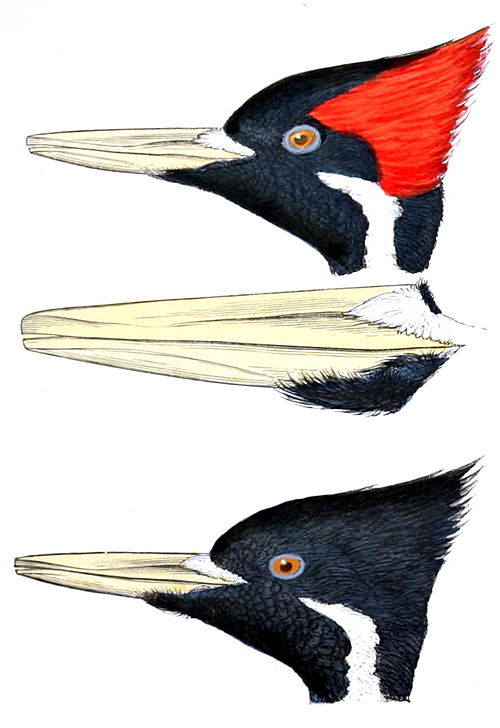
The contrast in plumage of the male (above) and female (below), separated by a detail of their bills

The original range of the ivory-billed woodpecker (white) in the United States (green)

Ivory-bills exchanging places in the nest, April 1935

Photograph of a male ivory-bill returning to the nest in order to relieve the female, Arthur A. Allen, April 1935.

A female ivory-billed woodpecker returning to the nest, April 1935, from the Singer tract expedition of Allen, Kellogg, Tanner, and Sutton, photograph Arthur A. Allen, April 1935.
![A comparison of the pileated woodpecker (top) with the ivory-billed woodpecker (bottom):[citation needed] superficial similarities of the birds result in pileated woodpeckers sometimes being mistaken for ivory-bills](https://upload.wikimedia.org/wikipedia/commons/thumb/7/7f/PileatedIvoryWoodpecker.svg/500px-PileatedIvoryWoodpecker.svg.png)
A comparison of the pileated woodpecker (top) with the ivory-billed woodpecker (bottom):[citation needed] superficial similarities of the birds result in pileated woodpeckers sometimes being mistaken for ivory-bills

Caption from Project Principalis paper, 2023: Composite figure comparing the size of three species of woodpeckers to the apparent ivory-billed woodpecker. Inset species were photographed on the same tree, with the same camera in the same place but at different times. These three images were extracted from their original frames and placed as insets on a fourth frame that shows the presumed ivorybill on October 1, 2021. All woodpeckers here are depicted at the same scale in their original, unedited size. Arrows point to the location of where each bird was located on the tree. Insets include an unidentified small woodpecker (top), a pileated woodpecker (middle), and a red-headed woodpecker (bottom). The presumed ivory-billed woodpecker is circled in white without an arrow.

Painting by John James Audubon
Temperament
elusive and wary
Flight Pattern
strong, direct flight with deep rapid wingbeats; occasionally glides between trees
Social Behavior
Typically observed singly or in mated pairs and believed to be monogamous. Nests were excavated high in large dead trees, with both sexes participating in excavation and care. Clutches were small, and territories were large, centered on areas rich in dead timber.
Migratory Pattern
Resident
Song Description
Gives a distinctive nasal, trumpet-like 'kent' note, often likened to a toy horn. Drumming consists of a powerful, resonant double knock with a brief pause between blows.
Plumage
Glossy black with broad white patches on the trailing wings and bold white stripes that run from the sides of the neck onto the back, forming a white 'saddle'. Males show a prominent red crest; females have a black crest.
Diet
Primarily feeds on wood-boring beetle larvae and other large insects extracted from recently dead or dying trees. It scales bark with powerful blows and pries off large slabs to reach larvae deep in the wood. Seasonally, it may supplement its diet with fruits, nuts, and seeds when insect prey is scarce.
Preferred Environment
Forages on large-diameter trunks and branches in mature bottomland forests and swamps with abundant snags. Frequently targets storm-damaged stands and areas with high beetle activity.