

The jackal buzzard is a fairly large African bird of prey. The taxonomy of this species has caused some confusion in the past and it almost certainly belongs in a species complex with other African Buteo species. Some taxonomists have considered this species, the Archer's buzzard, and the augur buzzard to be the same superspecies. Many taxonomists consider them all to be distinct, having different calls, different home ranges and variations in plumage. The species is resident and non-migratory throughout its range.
Region
Southern Africa
Typical Environment
Found across much of southern Africa, especially in South Africa, Lesotho, Namibia, Botswana and Eswatini. It favors rugged terrain with cliffs, escarpments, and rocky hills but also uses open grasslands, fynbos, Karoo scrub, and agricultural mosaics. It is common along road corridors where it perches and scans for prey or carrion. The species is largely sedentary and maintains territories year-round.
Altitude Range
Sea level to 3500 m
Climate Zone
Subtropical
Ease of Keeping
Beginner friendly: 1/5
This striking raptor of southern Africa often gives a loud, yelping call reminiscent of a black-backed jackal, which inspired its common name. It forms a species complex with several African Buteo, including augur and Archer's buzzards, but is treated as distinct by most authorities. Pairs reuse large stick nests for many years and are frequently seen perched on utility poles and rocky outcrops while hunting.


The striking patterns of adult jackal buzzards, blackish and rufous, is distinctive.

Taking flight near Greyton, South Africa
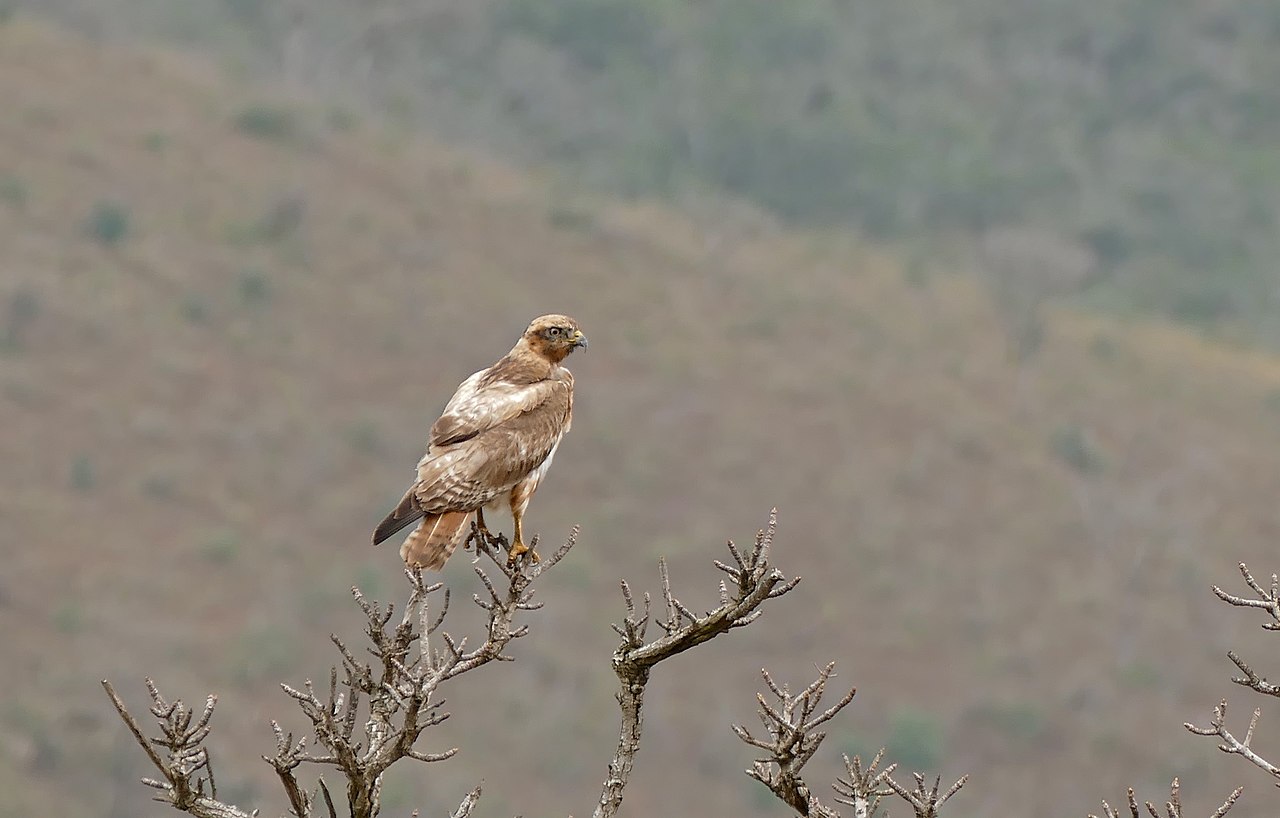
An immature Jackal Buzzard.
Temperament
solitary and territorial
Flight Pattern
soaring glider
Social Behavior
Typically seen alone or in pairs that defend large territories year-round. Pairs are monogamous and reuse substantial stick nests on cliffs, pylons, or tall trees. Clutches usually contain 1–2 eggs, and both adults share incubation and chick-rearing duties.
Migratory Pattern
Resident
Song Description
The call is a loud, yelping or mewing series of notes, often compared to the cry of a black-backed jackal. It calls frequently while soaring or near the nest, carrying well over open country.
Plumage
Boldly patterned with blackish head, back and upper chest, a contrasting white throat and breast patch, and rich rufous belly and tail; broad wings show pale panels with dark trailing edges in flight.
Diet
Prey includes small to medium mammals (especially rodents and hyrax), birds, lizards and snakes, and it readily scavenges carrion, including roadkill. It hunts from prominent perches or while soaring, dropping to seize prey on the ground. Opportunistic and adaptable, it may follow veld fires or agricultural activity to take exposed prey.
Preferred Environment
Hunts over open grassland, scrubby slopes, farm fields and along escarpments and rocky outcrops. Frequently patrols roadsides and fence lines where perches and carrion are abundant.


