
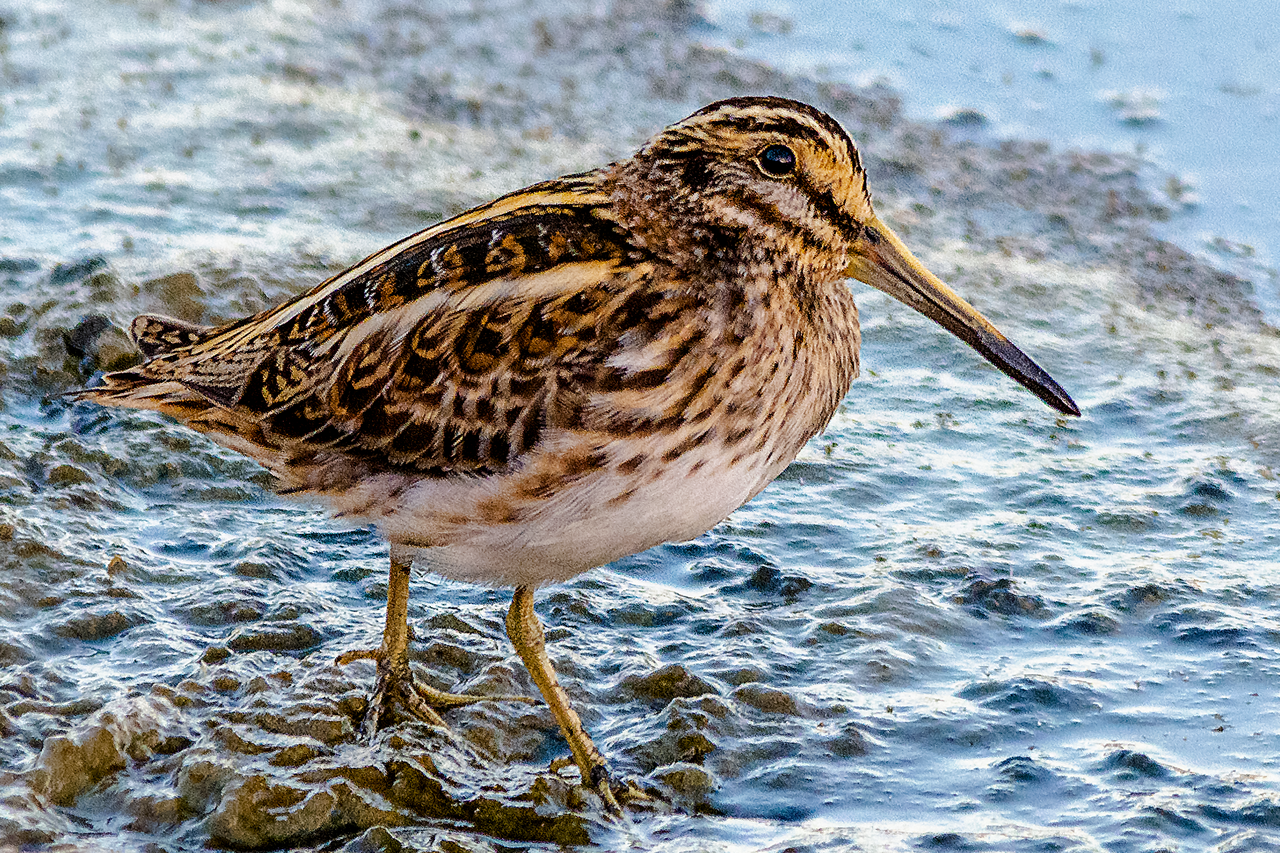
The jack snipe or jacksnipe is a small stocky wader. It is the smallest snipe, and the only member of the genus Lymnocryptes. Features such as its sternum and its continuous 'bobbing up and down' make it quite distinct from other snipes or woodcocks.
Region
Northern Eurasia
Typical Environment
Breeds across boreal peatlands and taiga bogs from Scandinavia and the Baltic region east through northern Russia and western Siberia. In winter it migrates to milder areas of western and southern Europe, the Mediterranean basin, North Africa, the Middle East, and parts of South and South‑East Asia. It favors wet, vegetated habitats such as fens, marshes, wet meadows, flooded fields, and reed-fringed pools with soft mud for probing.
Altitude Range
Sea level to 1500 m
Climate Zone
Temperate
Ease of Keeping
Beginner friendly: 1/5
The jack snipe is the smallest snipe and the sole member of its genus, noted for its distinctive, continuous bobbing motion while feeding. It flushes very late, often from almost underfoot, and usually flies low for a short distance before dropping back into cover. Unlike the common snipe, it lacks a pale central crown stripe and shows bold golden mantle stripes.


Lymnocryptes minimus

Jack snipe egg
Temperament
secretive and cryptic
Flight Pattern
flushes late with short, low zigzag flight before dropping quickly back into cover
Social Behavior
Generally solitary or in loose, spaced groups in non-breeding season, relying on camouflage rather than flocking. Nests on the ground in boggy vegetation, with a small, well-hidden scrape lined with plant material. Clutch size is typically four eggs, and the brood is precocial and mobile soon after hatching.
Migratory Pattern
Seasonal migrant
Song Description
Usually quiet outside the breeding season, giving a soft, short 'tchick' when flushed. On display, produces subdued, repetitive sounds and mechanical-like noises during aerial displays over breeding bogs.
Plumage
Highly cryptic, mottled brown with black and buff, showing bold golden-buff longitudinal stripes on the mantle and scapulars; underparts mostly whitish with barred flanks.
Diet
Feeds mainly on small invertebrates such as insect larvae, beetles, worms, small crustaceans, and mollusks. Probes soft mud with its sensitive bill tip and also picks items from the surface. Its characteristic bobbing or 'sewing-machine' motion is often seen while foraging along muddy margins.
Preferred Environment
Shallow muddy edges of marshes, wet meadows, fens, and flooded pastures with dense cover. Often selects areas with soft substrates and patchy vegetation that allow both concealment and probing.


