

The Indian eagle-owl, or the Bengal eagle-owl or rock eagle-owl, is a large horned owl species native to hilly and rocky scrub forests in the Indian subcontinent. It is splashed with brown and grey, and has a white throat patch with black small stripes. It was earlier treated as a subspecies of the Eurasian eagle-owl. It is usually seen in pairs. It has a deep resonant booming call that may be heard at dawn and dusk.
Region
Indian Subcontinent
Typical Environment
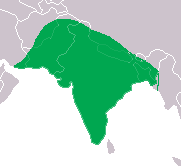
Found across much of India and into adjoining parts of Nepal, Sri Lanka, and Pakistan, it favors hilly and rocky scrub, dry deciduous woodland edges, ravines, and escarpments. It commonly uses cliffs, large boulders, and rocky outcrops for roosting and nesting. The species tolerates human-modified landscapes, hunting along field edges and village outskirts where prey is abundant. It generally avoids dense rainforest and very high elevations.
Altitude Range
0–1500 m
Climate Zone
Tropical
Ease of Keeping
Beginner friendly: 1/5
This large horned owl has striking orange eyes and long, slanted ear tufts that give it a formidable appearance. Its deep, resonant booming calls carry far and are most often heard at dusk and dawn, sometimes in duets from pairs. It often roosts on rocky ledges or within scrubby ravines by day and becomes an active ambush predator at night.


Indian eagle-owl in a museum

The underwing shows a dark carpal patch. The base of the primaries are unbarred.
Temperament
solitary and territorial
Flight Pattern
strong flier with deep, powerful wingbeats
Social Behavior
Usually encountered singly or in pairs; pairs maintain territories and may duet at twilight. Nests are typically on rocky ledges, in caves, or on sheltered ground scrapes, with 1–3 eggs. Adults roost discreetly by day and become active hunters after dusk.
Migratory Pattern
Resident
Song Description
A deep, resonant series of booming hoots, often rendered as far-carrying two-note phrases. Calls are most frequent at dusk and dawn and may be exchanged antiphonally between pair members.
Plumage
Heavily mottled and streaked brown and grey with buff tones; underparts buff with bold dark streaks. A conspicuous white throat patch shows fine black barring. Prominent ear tufts and a diffuse dark facial disc frame the face.
Diet
Primarily takes small to medium mammals such as rats, mice, and young hares; also preys on birds, reptiles, amphibians, and large insects. Hunts mainly from elevated perches, dropping swiftly onto prey or making short, powerful flights. Prey is swallowed whole when possible, with indigestible parts later cast as pellets.
Preferred Environment
Edges of scrub and dry woodland, rocky ravines, and open agricultural mosaics where prey is abundant. Frequently hunts along paths, field margins, and near villages at night.


