

The Indian jungle crow is a species of crow found across the Indian subcontinent south of the Himalayas. It is very common and readily distinguished from the house crow, which has a grey neck. In the past the species was treated as a subspecies of another crow species, but vocalizations and evidence from ectoparasite co-evolution and phylogenetic evidence have led to it being considered as a distinct species in modern taxonomic treatments. It differs in its voice from the large-billed crow found in the higher elevations of the Himalayas and the eastern jungle crow overlaps in the eastern part of its range. In appearance, it can be difficult to distinguish from either of these species although the plumage tends to be more uniformly glossed in purple and has a longer bill with a fine tip and a less arched culmen. The Himalayan species has a slightly wedge-shaped tail, unlike the rounded tail of the Indian jungle crow and tends to glide a lot.
Region
South Asia
Typical Environment
Occurs widely across peninsular India and Sri Lanka, primarily south of the Himalayan foothills. It uses a broad range of habitats from moist and dry forests to agricultural mosaics, villages, and large cities. Common around human habitation, it frequents markets, refuse sites, campuses, and roadsides. In natural settings it occupies forest edges, open woodland, and plantations, often foraging both on the ground and in the canopy.
Altitude Range
Sea level to 2000 m
Climate Zone
Tropical
Ease of Keeping
Beginner friendly: 2/5
This recently recognized species was split from the former ‘large-billed crow’ complex based on distinct vocal, morphological, and genetic evidence. It is uniformly black and lacks the grey neck of the house crow, a common source of confusion in cities. Its voice is notably different from the Himalayan and eastern jungle crows, aiding identification where ranges approach.

Comparison of bill shapes of culminatus (upper) and the more arched Himalayan form (lower)
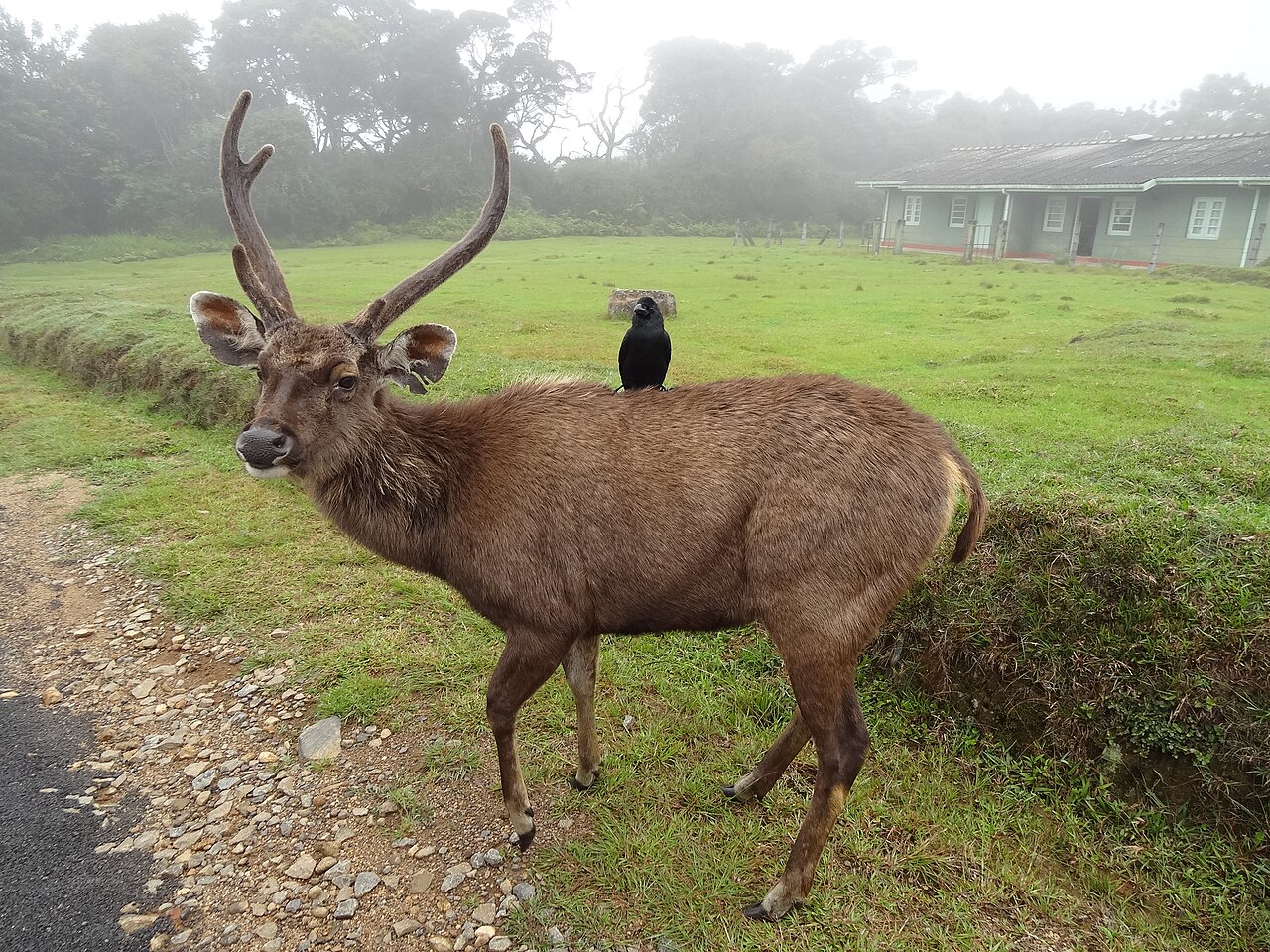
An Indian jungle crow perching on a sambar

Corvus ranges based on ectoparasites, after Klockenhoff (1969)

The bill shape difference is subtle -levaillantii (above) and culminatus (below)

Adult in Bharatpur, India
Temperament
social and bold
Flight Pattern
strong flier with steady wingbeats and occasional gliding
Social Behavior
Often seen in pairs or small groups, gathering at favored feeding sites and communal roosts. Nests are bulky stick platforms placed high in tall trees, with both parents involved in care. Outside the breeding season it may form loose flocks, especially near abundant food sources.
Migratory Pattern
Resident
Song Description
Calls are varied, deep, and resonant caws, often harsher and more guttural than related species. It produces a repertoire of drawn-out, metallic, and rattling notes, and call differences are a key field clue to its identity.
Plumage
Uniform glossy black with a purplish sheen; shaggy throat hackles; rounded tail; overall sleek, robust appearance.
Diet
An opportunistic omnivore that takes insects, other invertebrates, small vertebrates, eggs and nestlings, carrion, fruit, grains, and human food waste. It scavenges at refuse dumps and along roads, and will forage in fields for grubs and seeds. It also raids trees and bushes for fruits and occasionally caches surplus food.
Preferred Environment
Feeds in urban areas, markets, and rubbish tips, as well as along forest edges, plantations, and open countryside. Forages both on the ground and in the canopy, often near human activity.


