The house crow, also known as the Indian, greynecked, Ceylon or Colombo crow, is a common bird of the crow family that is of Asian origin but now found in many parts of the world, where they arrived assisted by shipping. It is between the jackdaw and the carrion crow in size but is slimmer than either. The forehead, crown, throat and upper breast are a richly glossed black, whilst the neck and breast are a lighter grey-brown in colour. The wings, tail and legs are black. There are regional variations in the thickness of the bill and the depth of colour in areas of the plumage.
Region
South Asia and many coastal cities worldwide
Typical Environment
Native across the Indian subcontinent and Sri Lanka, the house crow has established introduced populations in parts of the Middle East, East Africa, Southeast Asia, and some coastal areas of Europe. It is tightly associated with human settlements, especially ports, markets, and dense urban neighborhoods. It frequents coastal zones, mangroves, and agricultural edges but avoids dense forests and high mountains. Roosts are commonly in large urban trees and on man-made structures.
Altitude Range
0–2000 m
Climate Zone
Subtropical
Ease of Keeping
Beginner friendly: 1/5
House crows are highly adaptable urban birds that have spread globally with human shipping and trade. They thrive around ports, markets, and cities, where they scavenge and often act as invasive pests, displacing native birds and raiding nests. They are intelligent, social, and quick to learn, which makes them successful in new environments. Waste management and nest control are key strategies used to limit their spread in introduced regions.


Parents feeding nestlings

Nest with eggs

Eudynamys scolopaceus in a clutch of Corvus splendens - MHNT
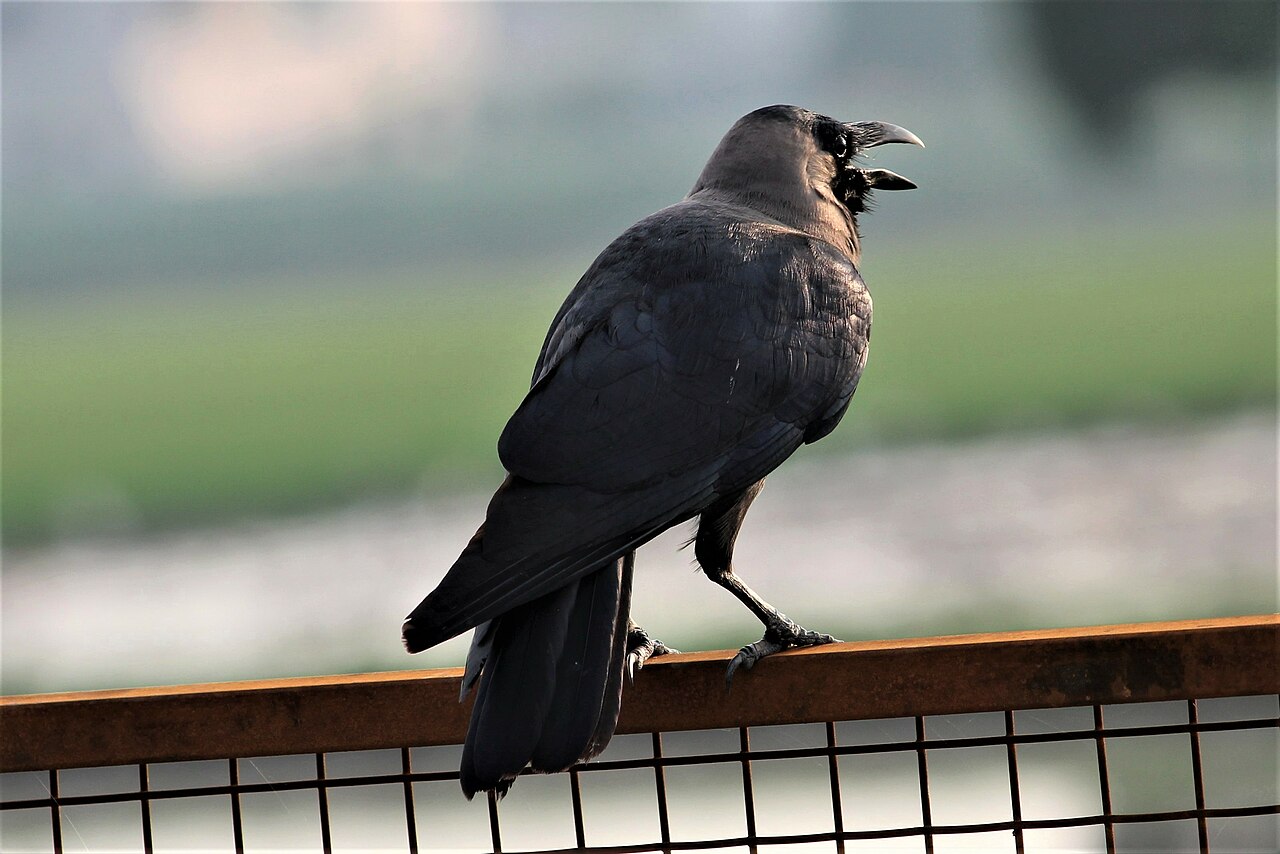
House crow near Chandigarh.




Temperament
social and bold
Flight Pattern
strong flier with steady wingbeats
Social Behavior
Forms noisy, dense communal roosts, often numbering in the hundreds or thousands. Typically breeds in loose colonies in tall trees, with pairs defending a small territory around the nest. Monogamous pairs cooperatively defend and provision their chicks. Highly opportunistic and quick to exploit new food sources.
Migratory Pattern
Resident
Song Description
Calls are sharp, nasal caws and rasping ‘kaa-kaa’ notes delivered in bursts. Vocal repertoire includes scolding, contact, and alarm calls, often given loudly from perches. Roosting flocks can be extremely noisy at dawn and dusk.
Plumage
Glossy black on the head, throat, upper breast, wings, and tail with a contrasting pale grey to grey-brown neck and nape forming a hooded look.
Diet
An opportunistic omnivore that consumes refuse, kitchen scraps, carrion, insects, small vertebrates, eggs and nestlings, grains, and fruit. It readily forages around markets, harbors, and garbage dumps. In coastal areas it takes marine invertebrates and fish scraps. Its diet flexibility underpins its success in urban and introduced environments.
Preferred Environment
Most feeding occurs in human-dominated settings—streets, markets, docks, and landfill sites. It also works agricultural edges and parks, probing vegetation and ground for insects and spilled grain.