
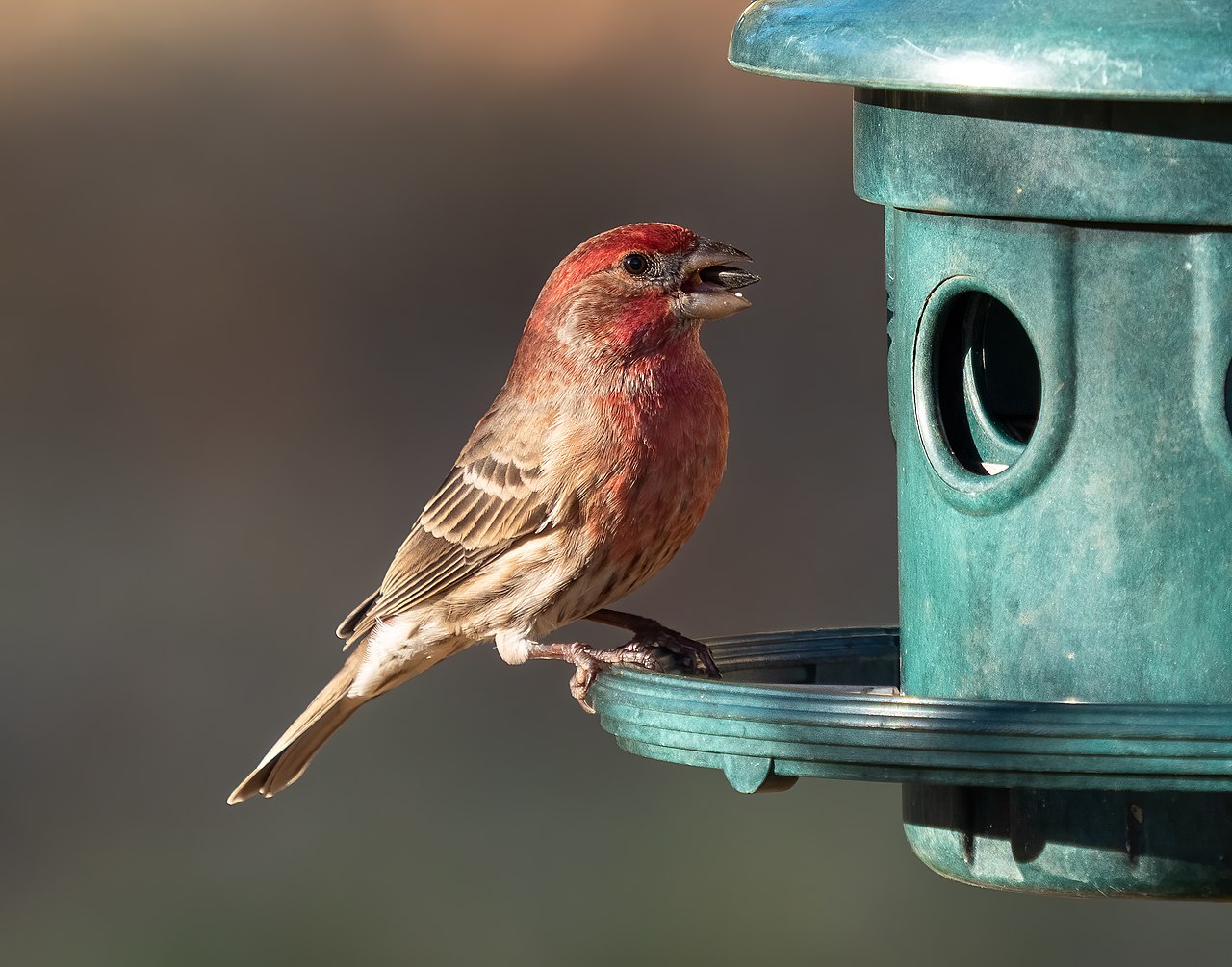
The house finch is a North American bird in the finch family. It is native to Mexico and southwestern United States, but has since been introduced to the eastern part of North America and Hawaiʻi; it is now found year-round in almost all parts of the United States and most of Mexico, with some residing near the border of Canada. There are estimated to be 40 million house finches across North America, making it the second-most populous finch, just behind the American goldfinch. The house finch and the other two American rosefinches are placed in the genus Haemorhous.
Region
North America and Hawaiian Islands
Typical Environment
Originally native to Mexico and the southwestern United States, the species now occupies most of the continental U.S. and parts of southern Canada after human-assisted introductions. It is common in cities, suburbs, parks, farms, deserts with scattered shrubs, and open woodlands. House finches readily nest on buildings, in hanging planters, and in dense shrubs. They are scarce in dense, unbroken forests and at very high elevations.
Altitude Range
Sea level to 2500 m
Climate Zone
Temperate
Ease of Keeping
Beginner friendly: 2/5
Males range from bright red to orange or yellow depending on dietary carotenoids, and females often prefer the reddest males. House finches thrive in urban and suburban settings and are frequent visitors to backyard feeders. Eastern populations suffered outbreaks of mycoplasmal conjunctivitis in the 1990s but many areas have since rebounded. They were historically sold as 'Hollywood finches' before releases led to their establishment in the eastern U.S.


Male eating kousa dogwood berry


A male house finch in the early morning light
Temperament
social and active
Flight Pattern
short rapid wingbeats with bounding, undulating flight
Social Behavior
Often forms loose flocks outside the breeding season and gathers at feeders. Pairs are typically monogamous; nests are built in shrubs, trees, or human structures and may be used for multiple broods per season. Nests are cup-shaped and females incubate while males provide food.
Migratory Pattern
Resident
Song Description
A bright, jumbled warble of sweet, rapid notes delivered from exposed perches. Calls include a sharp 'cheep' and rising 'wheee' notes, frequently given in flight or at feeders.
Plumage
Overall streaky brown with diffuse striping; males show bright, sometimes orange-yellowish, wash on head, breast, and rump. Females are more uniformly streaked brown and gray with a pale, blurry eyebrow and heavily streaked underparts.
Diet
Primarily seeds from grasses, weeds, and cultivated plants, supplemented with buds, fruits, and berries. They readily consume sunflower, millet, and other feeder seeds. Insects are taken opportunistically, especially for nestlings during the breeding season.
Preferred Environment
Feeds on the ground, in low shrubs and trees, and extensively at backyard feeders. Often forages along edges of open habitats, city parks, and residential areas.


