

The Himalayan bulbul, or white-cheeked bulbul, is a species of songbird in the bulbul family found in Central and South Asia.
Region
Western and Central Himalayas and adjoining northwestern South Asia
Typical Environment
Found from northeastern Afghanistan and northern Pakistan through Kashmir into the western and central Himalayan foothills of India and locally into Nepal. It inhabits scrubby hillsides, riverine thickets, open woodland, orchards, and village gardens. The species often occurs near human settlements where fruiting trees and hedges are available. It uses both natural shrublands and cultivated mosaics, moving locally with food availability.
Altitude Range
600–3000 m
Climate Zone
Highland
Ease of Keeping
Beginner friendly: 2/5
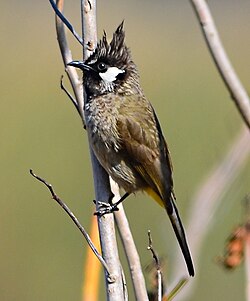
Also called the white-cheeked bulbul, it is a lively songbird of the western and central Himalayas and adjacent regions. It adapts well to human-modified landscapes, frequenting orchards, gardens, and forest edges. The bold white cheek patch and jaunty black crest make it easy to recognize even at a distance.

bulbul




Temperament
social and active
Flight Pattern
short rapid wingbeats
Social Behavior
Typically seen in pairs or small groups, becoming more gregarious outside the breeding season. Builds a cup-shaped nest in shrubs or low trees, where 2–4 eggs are laid. Both parents share incubation and feeding duties.
Migratory Pattern
Partial migrant
Song Description
A lively, ringing series of whistles, chatters, and trills, often delivered from exposed perches. Phrases are repeated with cheerful urgency and carry well across valleys.
Plumage
Brown upperparts with a slightly scaled pale underpart, contrasting black head with a pointed crest and a bold white cheek patch; vent area distinctly yellow with white-tipped tail feathers.
Diet
Eats a mixed diet of fruits and berries, flower nectar, and small invertebrates such as beetles, caterpillars, and ants. It frequently gleans from foliage and twigs and will hawk briefly for flying insects. Seasonal fruiting influences local movements and flocking behavior.
Preferred Environment
Feeds in shrubland edges, orchards, and gardens where fruiting trees and hedges are abundant. Also forages along forest margins and riparian thickets, often at low to mid canopy levels.


