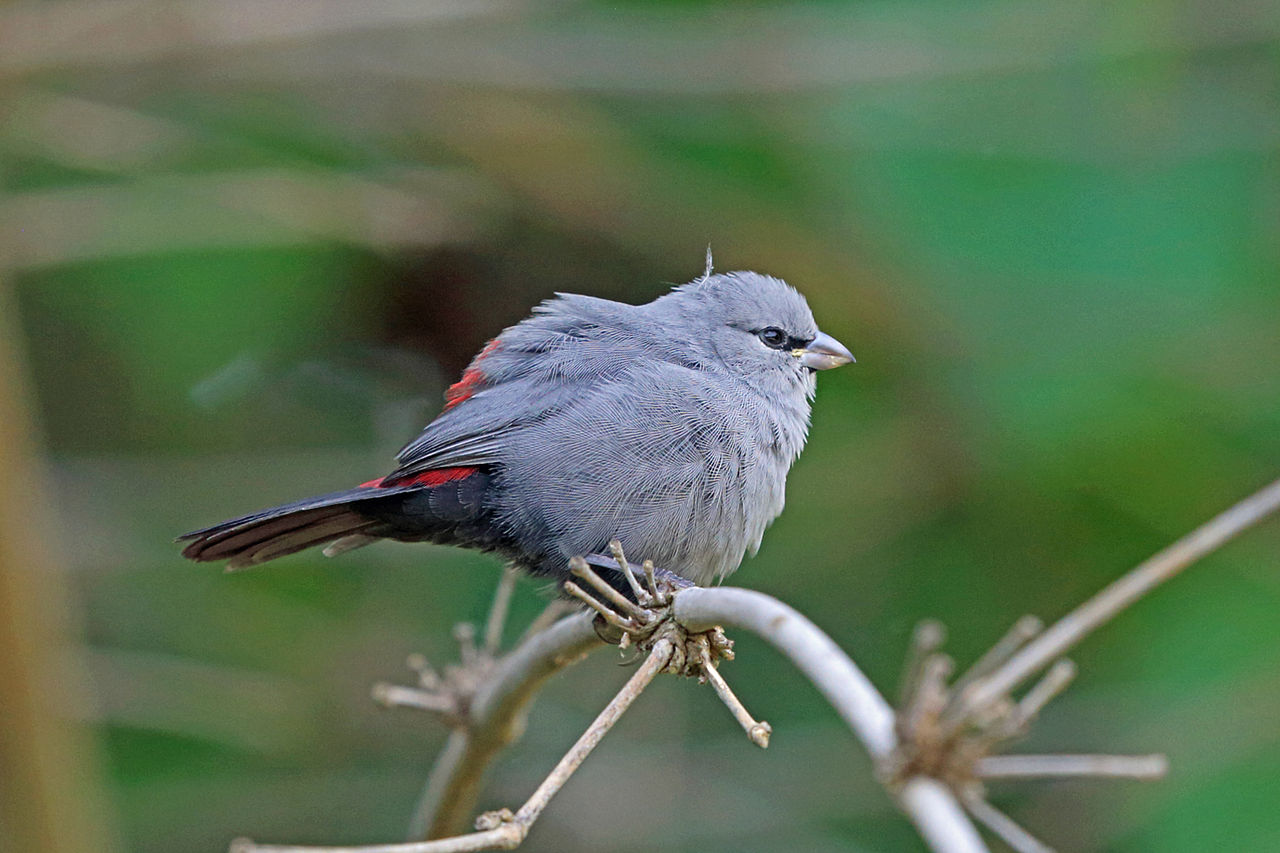
The grey tit-flycatcher is a species of bird in the family Muscicapidae. It has an extensive but patchy distribution in sub-Saharan Africa.
Region
Sub-Saharan Africa
Typical Environment
Occurs patchily but widely from West and Central Africa through the Congo Basin to East and parts of Southern Africa. It favors moist lowland and montane forests, gallery forests, forest edges, and well-wooded riparian habitats. The species also uses secondary growth and woodland mosaics adjacent to forest. It generally keeps to the shaded understory and mid-canopy, occasionally venturing into clearings or edges to sally for insects.
Altitude Range
Sea level to 2200 m
Climate Zone
Tropical
Ease of Keeping
Beginner friendly: 1/5
Despite its name, the grey tit-flycatcher is a true Old World flycatcher that often forages like a tit, creeping along branches and flicking its tail. It frequently joins mixed-species flocks in forests, where its quiet, whistled calls can give it away. It adapts well to secondary growth and forest edges, which helps it persist across a wide range.


The tail is often flicked and fanned.
Temperament
solitary and territorial
Flight Pattern
short rapid wingbeats with brief sallies
Social Behavior
Usually found singly or in pairs within territories, often joining mixed-species flocks while foraging. Pairs nest in a small cup placed low to mid-level in dense vegetation. Both parents participate in feeding the young, and adults frequently flick wings and tail during foraging.
Migratory Pattern
Resident
Song Description
Soft, high-pitched whistles and thin trills, delivered in short repeated phrases. Contact calls are quiet chips and tsit notes, easily overlooked in dense foliage.
Plumage
Mostly plain lead-grey with slightly paler grey underparts and throat; wings and tail are dusky grey without bold bars. Feathers appear smooth and sleek, giving a uniform look in shade. Bill and legs are dark, and a subtle pale eye ring may be visible at close range.
Diet
Primarily small insects such as flies, beetles, caterpillars, and other arthropods. It gleans from leaves and twigs and makes short sallies to catch prey in mid-air. Occasional small spiders are taken, and it may rarely sample tiny berries when insects are scarce.
Preferred Environment
Forages in shaded understory and mid-canopy of forests, along forest edges, and in gallery woodland. Often accompanies mixed flocks, taking advantage of disturbed insects and shared vigilance.