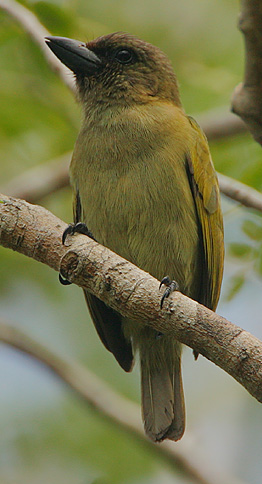
The green barbet is a species of bird in the Lybiidae family. It is found in Kenya, Tanzania, Malawi, Mozambique and South Africa. It occurs in forests from sea level to 1,800 metres (5,900 ft). Its isolated populations are vulnerable to forest clearing.
Region
East and Southeastern Africa
Typical Environment
Occurs in coastal, lowland, and montane forests from southern Kenya through Tanzania to Malawi, Mozambique, and northeastern South Africa. It favors mature evergreen and riverine forests with abundant fruiting trees, especially figs. Birds are most often encountered in the mid- to upper canopy and along forest edges and clearings. It tolerates secondary growth but declines where large tracts of forest are cleared.
Altitude Range
Sea level to 1800 m
Climate Zone
Tropical
Ease of Keeping
Beginner friendly: 1/5
The green barbet is a canopy-dwelling African barbet that relies heavily on fruiting trees, especially figs. Its far-carrying, repetitive hooting often reveals its presence in dense forest. Isolated populations are sensitive to forest loss and fragmentation. Pairs excavate their own nest cavities in dead wood using their stout bills.


1897 illustration of a pair of Woodward's barbets, by J.G. Keulemans.
Temperament
shy and canopy-oriented
Flight Pattern
short rapid wingbeats with undulating flights between trees
Social Behavior
Usually seen in pairs or small family groups, sometimes joining mixed-species flocks around fruiting trees. Strongly territorial during breeding. Both sexes excavate nest cavities in soft or dead wood and share incubation and chick rearing.
Migratory Pattern
Resident
Song Description
A loud, repetitive series of hollow hoots that can carry over long distances, often delivered in steady tempo. Pairs may duet, overlapping phrases in a rhythmic exchange.
Plumage
Mostly olive-green with a slightly paler, sometimes yellow-washed throat and faint mottling on the underparts; upperparts are uniform olive with a sturdy, pale bill and sparse rictal bristles.
Diet
Primarily eats fruit, especially figs and other soft, pulpy berries. Supplements its diet with insects and other small invertebrates gleaned from foliage and bark. Occasionally takes seeds or nectar when available. Seasonal availability of fruit influences local movements and foraging intensity.
Preferred Environment
Forages high in the canopy of mature forest and along edges, frequently visiting fruiting trees. Will descend to mid-levels and clearings when fruit is abundant.