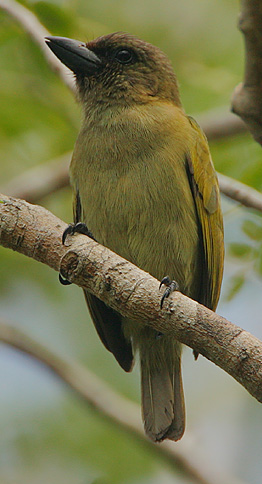
The green avadavat or green munia is a species of Estrildid finch with green and yellow on the body, a bright red bill and black "zebra stripes" on the flanks. They are endemic to the Indian subcontinent and were formerly popular as cagebirds. The name "avadavat" is a corruption of the name the city of Ahmedabad in Gujarat, India, which was a centre of bird trade. They have a restricted distribution and populations are threatened by the bird trade.
Region
South Asia
Typical Environment
The green avadavat occurs patchily in India, especially in northwestern and central regions such as Rajasthan and Gujarat, with scattered records elsewhere on the subcontinent. It favors dry scrub, rank grasslands, edges of cultivation, and open woodland with thickets. Birds often keep close to cover and are seen in small flocks at seeding grasses. They may use rocky hillsides with scrub and areas near water where tall grasses persist.
Altitude Range
Sea level to 1500 m
Climate Zone
Subtropical
Ease of Keeping
Beginner friendly: 2/5
Also called the green munia, this small estrildid finch has striking black-and-white barred flanks and a bright red bill. It is heavily threatened by trapping for the cagebird trade and habitat loss, and is now legally protected in India. The common name “avadavat” derives from Ahmedabad in Gujarat, historically a center of bird trade. Birds are often secretive, sticking to tall grasses and scrub.


Temperament
social and wary
Flight Pattern
short rapid wingbeats with undulating flight
Social Behavior
Outside the breeding season it forms small to medium flocks that move between feeding patches and roost communally in dense grass. During breeding, pairs separate from flocks and become more territorial near the nest site. Nests are domed structures of grass hidden low in tall vegetation or shrubs.
Migratory Pattern
Resident
Song Description
A soft, sweet warbling delivered from cover or low perches, interspersed with thin tsee and sip contact notes. The song is modest in volume but persistent during the breeding season.
Plumage
Olive-green upperparts with yellowish underparts and bold black-and-white 'zebra' barring on the flanks; tail dark. Plumage is smooth and close-fitting, with subtle gloss on the upperparts.
Diet
Primarily takes small grass seeds and the seeds of weeds and crops, husking them with its stout conical bill. It also gleans tender shoots and occasionally small invertebrates, especially during the breeding season to feed nestlings. Foraging is mostly on or near the ground, moving methodically through seeding grass heads.
Preferred Environment
Feeds along edges of fields, fallow plots, weedy scrub, and tall-grass patches, often close to cover. It also visits harvested stubble and paths where seeds accumulate.