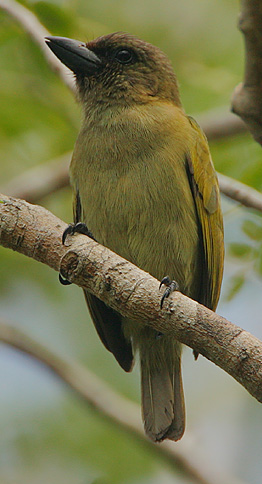
The green araçari, is a toucan, a near-passerine bird. It is found in the lowland forests of northeastern South America, in the northeast Amazon Basin, the Guianas and the eastern Orinoco River drainage of Venezuela. At 30–40 cm. (12–16 in) long and weighing 110–160 grams, it is the smallest aracari in its range, and among the smallest members of the toucan family.
Region
Northeastern South America
Typical Environment
Occurs in the Guianas, northeastern Amazon Basin of Brazil, and the eastern Orinoco drainage of Venezuela. Inhabits lowland evergreen rainforest, flooded and riverine forests, and forest edges. It readily uses secondary growth, gallery forests along rivers, and fruiting trees in clearings. Typically avoids open habitats and higher elevations, staying near dense canopy cover.
Altitude Range
Sea level to 600 m
Climate Zone
Tropical
Ease of Keeping
Beginner friendly: 2/5
The green aracari is the smallest aracari in its range and among the smallest toucans, using its long, lightweight bill to reach fruit and aid in heat regulation. It is an important seed disperser in lowland forests and is often seen moving in small, noisy groups through the canopy. They nest in tree cavities, sometimes reusing old woodpecker holes.


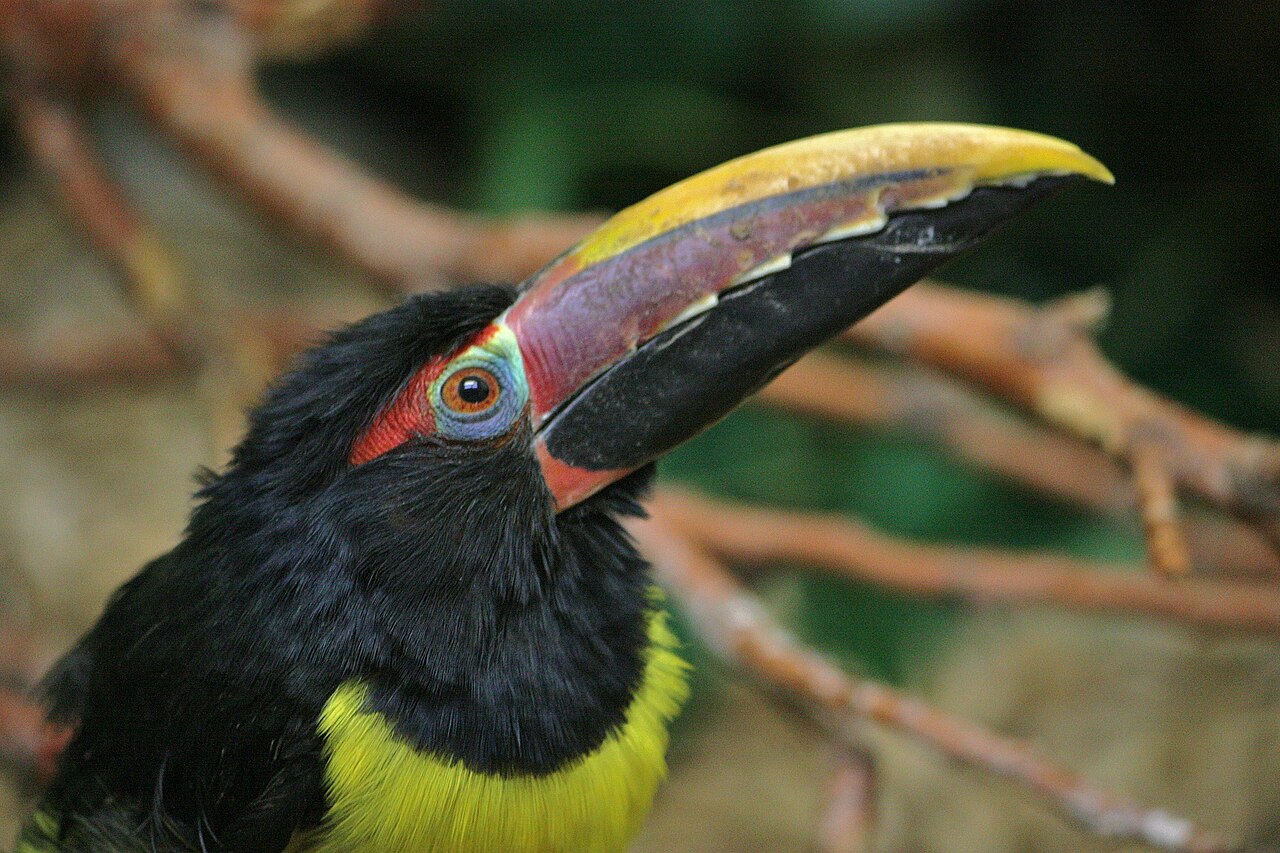
Males differ from females in having a black hood, but have the same characteristic bill pattern. Denver Zoo, Denver, Colorado.
Temperament
social and active
Flight Pattern
short rapid wingbeats with brief glides between trees
Social Behavior
Usually travels in pairs or small groups, sometimes joining mixed-species flocks at fruiting trees. Nests in natural cavities or old woodpecker holes; both sexes share incubation and chick-rearing duties. Roosting can be communal, with several birds squeezing into the same cavity.
Migratory Pattern
Resident
Song Description
Vocalizations are sharp, high-pitched yelps and squeaky, repetitive notes that carry through the canopy. Calls often accelerate into chatters when groups are excited or moving between fruiting trees.
Plumage
Olive-green upperparts with yellow underparts crossed by a broad red belly band; black cap; throat pale to chestnut-tinged; long, narrow, brightly patterned bill.
Diet
Primarily consumes a wide variety of soft fruits and berries, swallowing them whole and later regurgitating seeds, which aids forest regeneration. Also opportunistically takes insects and other small invertebrates, and may raid nests for eggs or nestlings. Uses its long bill to reach fruit at the tips of branches. Frequently follows fruiting cycles and moves locally to track food availability.
Preferred Environment
Feeds high in the canopy at fruiting trees, but also visits forest edges and river margins. Will exploit secondary forests, gardens with large fruiting trees, and forest gaps.