

The greater crested tern, also called crested tern, swift tern, or great crested tern, is a tern in the family Laridae that nests in dense colonies on coastlines and islands in the tropical and subtropical Old World. Its four or five subspecies breed in the area from South Africa around the Indian Ocean to the central Pacific and Australia, all populations dispersing widely from the breeding range after nesting. This large tern is closely related to other species in its genus, but can be distinguished by its darker, battleship-grey upperparts, white forehead even in full breeding plumage, and greenish-tinged yellow bill colour.
Region
Indo-Pacific
Typical Environment
Occurs along tropical and subtropical coastlines from southern Africa around the Indian Ocean to the western and central Pacific and Australia. Prefers marine environments near shore, including sandy beaches, coral reefs, lagoons, and estuaries. Breeds on offshore islands and exposed sandbars with minimal vegetation. Foraging typically takes place over nearshore waters and tidal rips where small schooling fish are concentrated.
Altitude Range
Sea level to 100 m
Climate Zone
Subtropical
Ease of Keeping
Beginner friendly: 1/5
The greater crested tern breeds in dense colonies on sandy or rocky islands and coastal sandspits, often alongside other seabirds. It can be told from similar large terns by its darker, battleship-grey upperparts, white forehead even in full breeding plumage, and a greenish-tinged yellow bill. After nesting, birds disperse widely across warm coastal waters and may travel great distances. Courtship often includes fish-offering displays and synchronized calls.


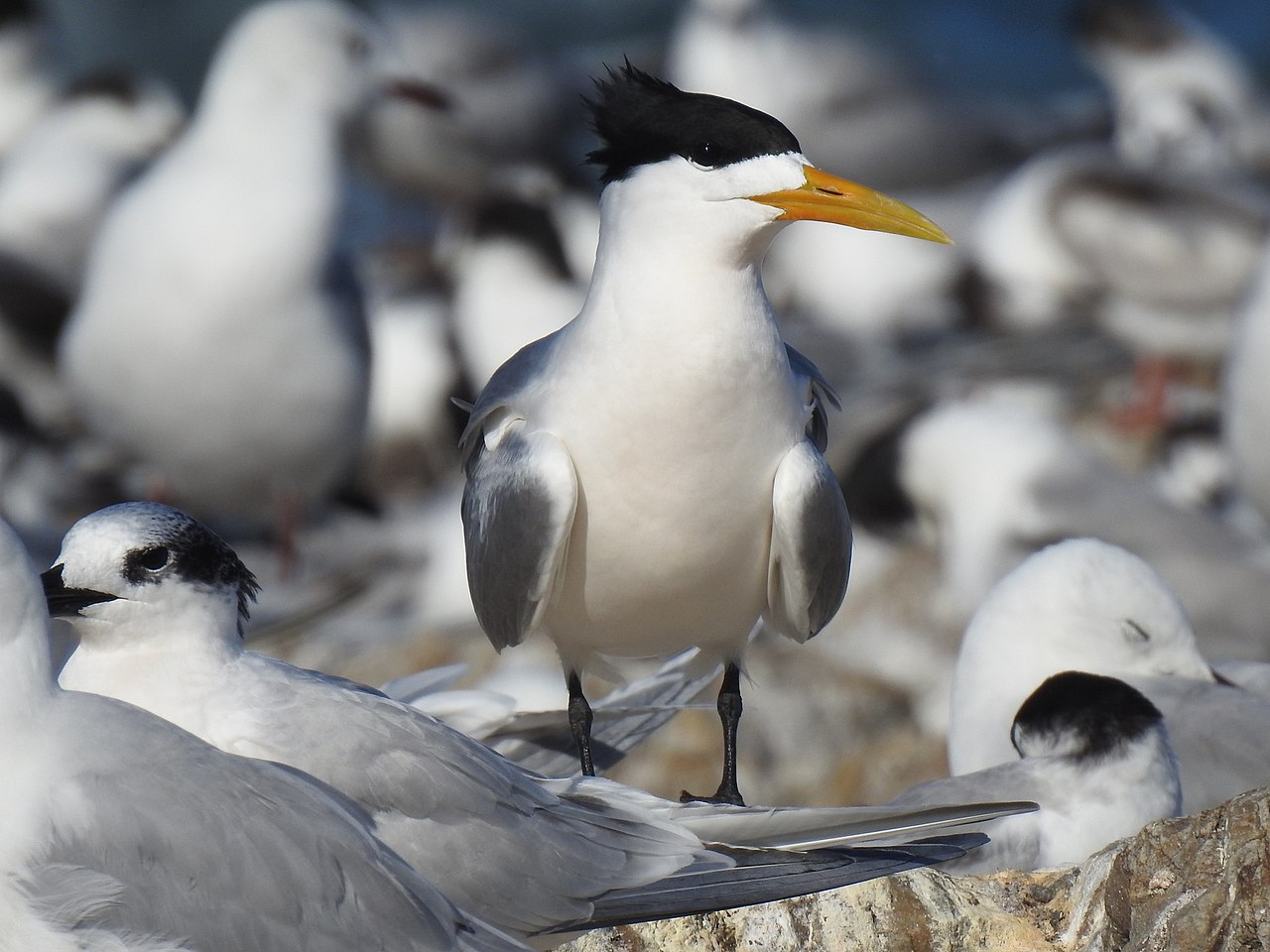


T. b. cristatus immature, French Polynesia

Roosting with little terns, note size difference

T. b. cristatus displaying

Greater crested tern chick with parents on Penguin Island, Western Australia

Breeding plumage in New South Wales

A nesting colony in Tubbataha Reef, Philippines

Egg, Collection Museum Wiesbaden

Nominate subspecies roosting with Sandwich terns in South Africa

Greater crested tern with prey caught via a surface dip

Greater crested tern with a fish in its beak

Bycatch from prawn fishing can provide extra food
Temperament
social and active
Flight Pattern
strong flier with rapid wingbeats and agile plunge-dives
Social Behavior
Highly colonial breeder, nesting in dense, noisy aggregations on islands and sandspits. Pairs are generally monogamous within a season; both sexes incubate and feed the chick. Adults defend nest sites vigorously against intruders and predators. Courtship includes aerial chases and fish presentations.
Migratory Pattern
Partial migrant
Song Description
Vocal, with loud, harsh, scolding calls such as kreeeik and kyeer that carry over colonies and at sea. Calls become especially frequent during courtship, territory defense, and feeding interactions.
Plumage
Upperparts dark, battleship-grey with white underparts; black cap forming a shaggy crest in breeding season with a contrasting white forehead; primaries show a darker wedge.
Diet
Feeds mainly on small schooling fish such as anchovies and sardines, captured by plunge-diving from several meters above the surface. Also takes small squid and occasionally crustaceans. Often forages in areas of upwelling or tidal currents that concentrate prey, and may follow predatory fish or marine mammals driving shoals to the surface.
Preferred Environment
Usually hunts in nearshore marine waters, surf zones, reef edges, bays, and estuaries. Frequently seen around harbors and coastal headlands where fish schools gather. Roosts on beaches, sandbars, and rocky islets between feeding bouts.


