

The great spotted kiwi, great grey kiwi or roroa is a species of kiwi endemic to the South Island of New Zealand. The great spotted kiwi, as a member of the ratites, is flightless. It is the largest of the kiwi. The rugged topography and harsh climate of the high altitude alpine part of its habitat render it inhospitable to a number of introduced mammalian predators, which include dogs, ferrets, cats, and stoats. Because of this, populations of this species have been less seriously affected by the predations of these invasive species compared to other kiwi. Nonetheless, there has been a 43% decline in population in the past 45 years, due to these predators and habitat destruction. This has led it to be classified as vulnerable. There are less than 16,000 great spotted kiwis in total, almost all in the more mountainous parts of northwest Nelson, the northwest coast, and the Southern Alps. A minority live on island reserves.
Region
South Island, New Zealand
Typical Environment
Occurs mainly in rugged, high-rainfall landscapes of northwest Nelson, the northern West Coast, and along the Southern Alps, with some populations on predator-free islands. It uses subalpine shrublands, tussock grasslands, and montane podocarp–hardwood forests, often near rocky outcrops. By day it shelters in burrows, hollow logs, root cavities, or rock crevices. At night it forages on the forest floor and along stream margins, probing soft soils and leaf litter.
Altitude Range
Sea level to 1500 m
Climate Zone
Temperate
Ease of Keeping
Beginner friendly: 1/5
The great spotted kiwi (roroa) is the largest of the kiwi and is completely flightless, with hair-like plumage and tiny vestigial wings. Unusually for birds, its nostrils are at the tip of the long bill, helping it sniff out prey underground. It forms long-term pairs and is mostly nocturnal. While alpine strongholds reduce predator pressure, dogs, stoats, and habitat loss continue to threaten the species.


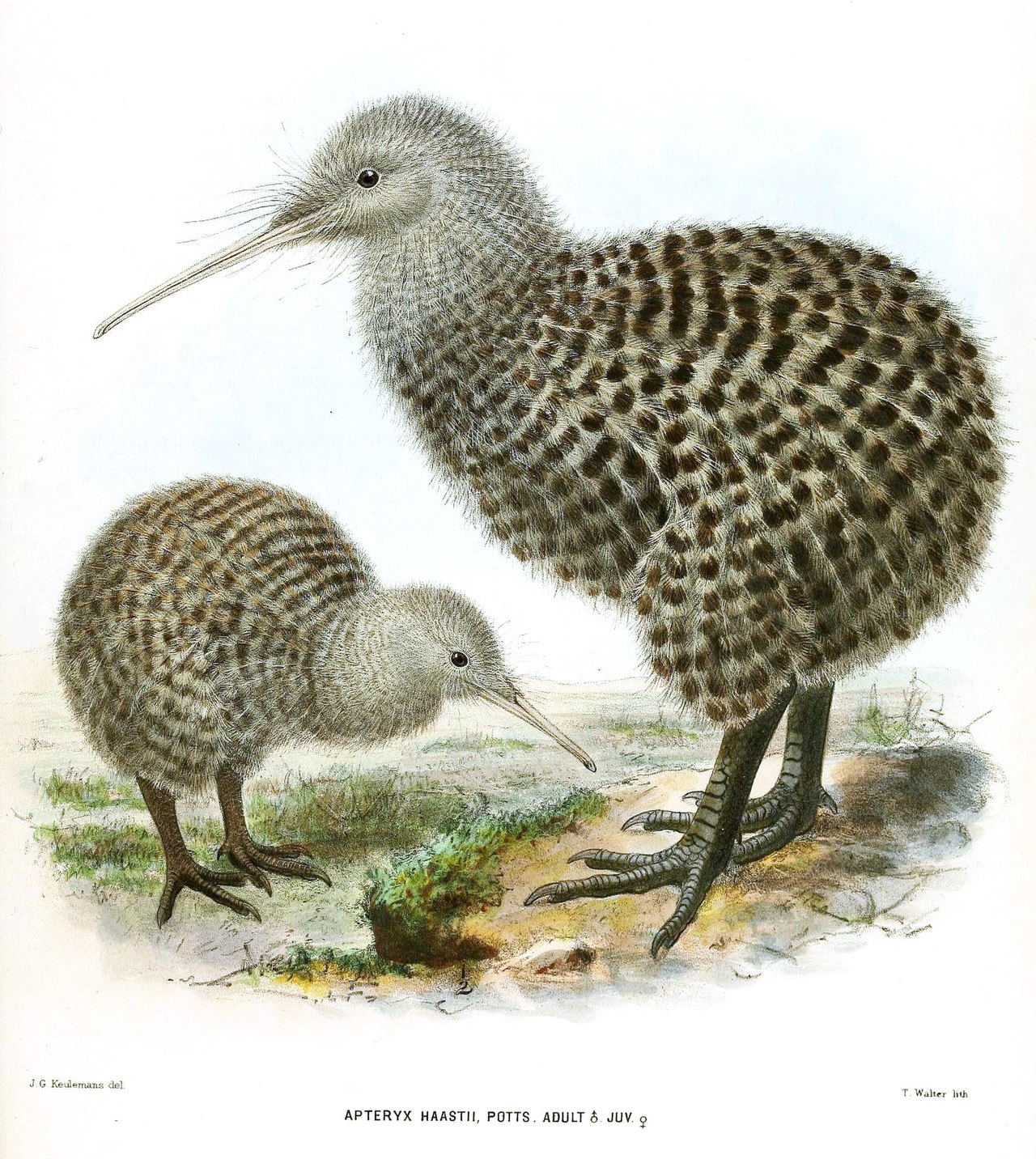
Illustration of an immature and an adult male

An example of a tussock grassland, which great spotted kiwis will inhabit

Stuffed specimen from Auckland Museum

A scientist prepares to release a great spotted kiwi as part of a conservation program in Kahurangi National Park
Temperament
nocturnal, secretive, and territorial
Flight Pattern
flightless; swift runner
Social Behavior
Typically forms long-term monogamous pairs that defend year-round territories using calls and scent marking. Nests are in burrows, hollow logs, or rock crevices. The male does most of the incubation, though the female may assist; chicks are precocial and leave the nest early.
Migratory Pattern
Resident
Song Description
Males give a series of high-pitched, rising whistles repeated in rapid succession; females respond with lower, harsher calls. Duets carry long distances on calm nights and are used to advertise territory.
Plumage
Coarse, shaggy, hair-like feathers with heavy mottling; overall speckled appearance.
Diet
Feeds mainly on invertebrates such as earthworms, beetles, larvae, wētā, spiders, and other soil-dwelling insects. It also takes occasional berries, seeds, and fungi, and may probe for small freshwater invertebrates along streams. The sensitive bill tip detects vibrations and scent to locate prey underground.
Preferred Environment
Forages on damp forest floors, subalpine scrub, tussock margins, and along stream edges with soft soils. Prefers dense ground cover and complex microhabitats for probing and gleaning.


