

The great tit is a small passerine bird in the tit family Paridae. It is a widespread and common species throughout Europe, the Middle East, Central Asia and east across the Palearctic to the Amur River, south to parts of North Africa where it is generally resident in any sort of woodland; most great tits do not migrate except in extremely harsh winters. Until 2005 this species was lumped with numerous other subspecies. DNA studies have shown these other subspecies to be distinct from the great tit and these have now been separated as two distinct species, the cinereous tit of southern Asia, and the Japanese tit of East Asia. The great tit remains the most widespread species in the genus Parus.
Region
Palearctic (Europe, North Africa, and temperate Asia)
Typical Environment
Found across woodlands, parks, gardens, hedgerows, and riparian groves from western Europe through the Middle East to the Amur region. Prefers mixed and deciduous forests but also thrives in urban and suburban green spaces. Often associated with areas that offer tree cavities or nest boxes for breeding. In more arid or open landscapes it concentrates along wooded corridors and shelterbelts.
Altitude Range
Sea level to 2500 m
Climate Zone
Temperate
Ease of Keeping
Beginner friendly: 2/5
Great tits are bold, adaptable birds that readily use nest boxes and visit garden feeders. Males typically show a broader black stripe down the yellow belly than females, helping with sexing in the field. They have a varied, teachery two-note song but can mimic and use many call types. Remarkably, in harsh winters they have been recorded preying on hibernating bats, showcasing unusual opportunism.


Great tit in Sweden, winter 2016

The 11 subspecies of the cinereous tit were once lumped with the great tit but recent genetic and bioacoustic studies now separate that group as a distinct species

At Kew Gardens, London. The British subspecies P. m. newtoni has a wider mid-line ventral stripe on the lower belly than the nominate race

Great tit on a branch

In females and juveniles the mid-line stripe is narrower and sometimes discontinuous
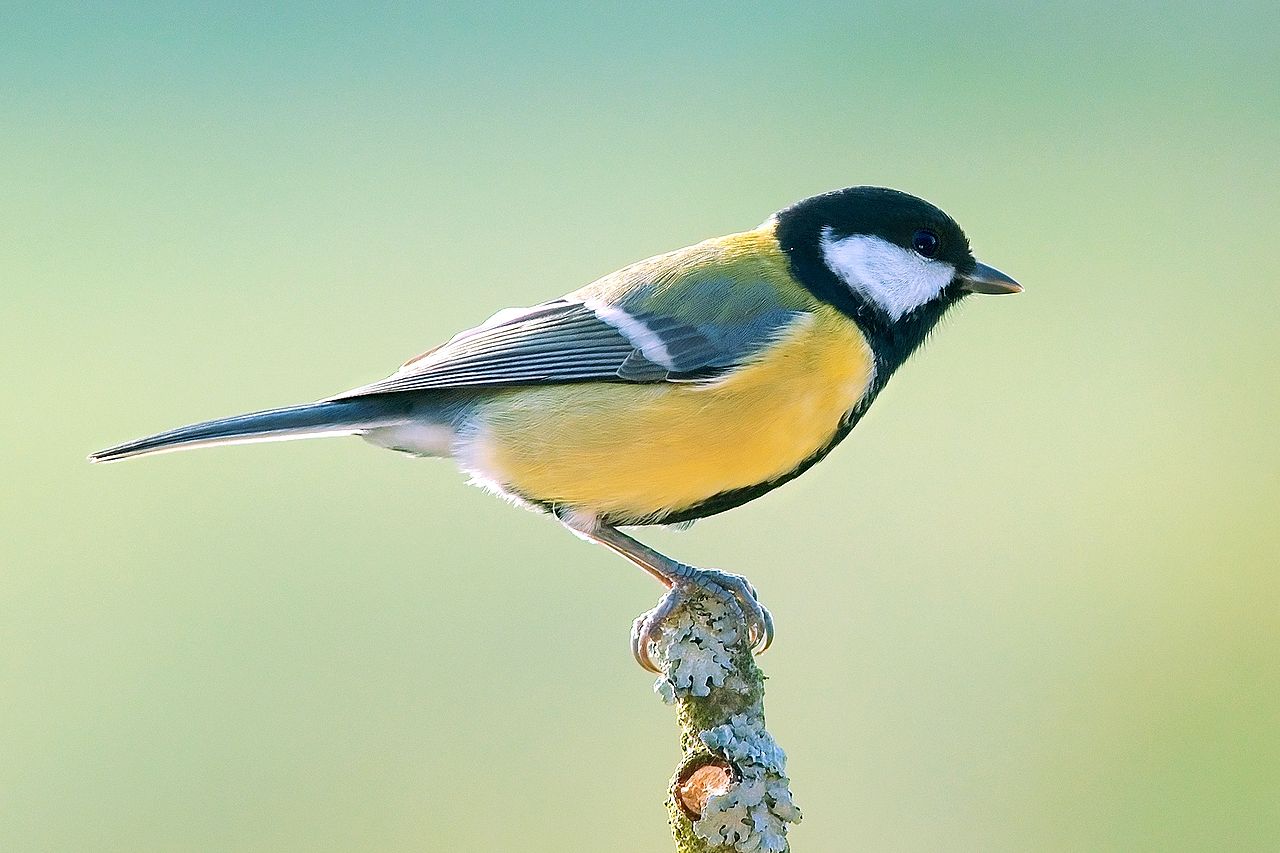
The plumage of the male is typically bright, although this varies by subspecies

Female great tit (left) and male (right)

Great tit twittering

Mixed forests are one of the habitats great tits use in Europe

A nest box in Altenbeken, Germany

Like other tits, great tits transport food with their beak, and then transfer it to their feet, where it is held while they eat

Great tit feeding its young with an insect

Eggs, Collection Museum Wiesbaden

Young chicks in the nest

Leaving nest box

Great tit nesting in nest box

Fledgling

The great tit's willingness to use bird-feeders and nesting boxes makes it popular with the general public and useful to scientists
Temperament
social and active
Flight Pattern
short rapid wingbeats with undulating flight
Social Behavior
Breeds in cavities and readily uses nest boxes; pairs defend territories during the breeding season. Clutches are relatively large, timed to peaks in caterpillar abundance. Outside breeding, they form small flocks and often join mixed-species foraging groups with other tits and woodland passerines.
Migratory Pattern
Partial migrant
Song Description
Loud, clear two-note phrases often rendered as 'teacher-teacher', repeated insistently. Calls include scolds, chips, and nasal notes, with considerable variation and local dialects.
Plumage
Striking contrast with glossy black head and throat, large white cheek patches, olive-green back, and yellow underparts with a black central stripe. Blue-grey wings with a pale wing bar and white fringes; tail is dark with white outer feathers.
Diet
In spring and summer it feeds heavily on insects and spiders, especially caterpillars gleaned from foliage. In autumn and winter it switches to seeds, nuts, and buds, and frequently visits feeders for sunflower seeds, peanuts, and suet. Occasionally exhibits opportunistic predation on small vertebrates or hibernating bats in severe conditions.
Preferred Environment
Forages from canopy to shrubs, probing bark and twigs and hanging acrobatically to reach prey. Common at garden feeders and edges of woodlands, and will cache food in crevices.


