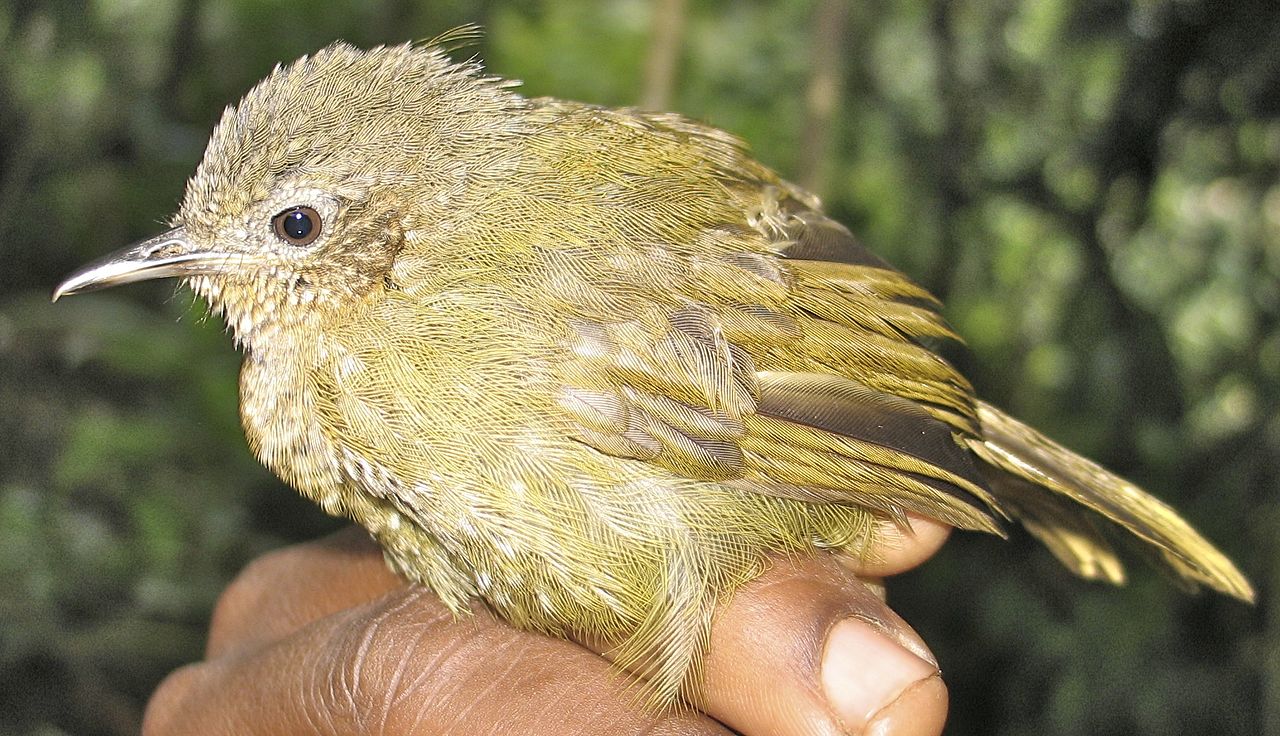
Grauer's broadbill, also known as the African green broadbill, is a species of bird in the family Eurylaimidae, and is monotypic within the genus Pseudocalyptomena. Its name commemorates the German zoologist Rudolf Grauer who collected natural history specimens in the Belgian Congo.
Region
Albertine Rift (DRC and southwest Uganda)
Typical Environment
Occurs in humid montane forest of the eastern Democratic Republic of the Congo and adjacent southwest Uganda, including Bwindi Impenetrable and Itombwe–Kahuzi-Biega ranges. It favors primary forest with a dense midstory and abundant fruiting trees, especially figs, and will use mature secondary forest where structure is intact. Typically keeps to interior forest but may approach natural gaps and fruiting-tree clearings. It perches quietly in the mid-canopy and moves between fruiting trees in short flights.
Altitude Range
1600–2600 m
Climate Zone
Highland
Ease of Keeping
Beginner friendly: 1/5
Grauer's broadbill (African green broadbill) is the sole member of the genus Pseudocalyptomena, a relict African lineage of broadbills. It inhabits the Albertine Rift's humid montane forests and is highly dependent on mature, undisturbed canopy with fruiting trees, especially figs. Its unobtrusive, leaf-green plumage makes it easy to overlook as it sits quietly in the midstory. Habitat loss and forest degradation are the main threats to this species.


Temperament
shy and inconspicuous
Flight Pattern
short rapid wingbeats between perches; low, undulating hops through midstory
Social Behavior
Usually found singly, in pairs, or small family groups, and often attends fruiting trees. May loosely join mixed-species flocks around abundant fruit. Nest is a hanging, purse-like structure of plant fibers and moss suspended from a branch in dense foliage. Both sexes likely participate in nesting duties.
Migratory Pattern
Resident
Song Description
Quiet, thin, high-pitched whistles and seee notes, often delivered from concealed perches. Calls can be ventriloquial and are more often heard at dawn and early morning than later in the day.
Plumage
Compact, leaf-green bird with softer, mossy-green body tones and darker greenish-black wings edged lighter; plumage appears smooth and uniform in the canopy light. Subtle dusky markings around the ear-coverts and a faint malar line. Tail short; bill broad-based and flattened but relatively small and inconspicuous.
Diet
Takes a variety of small fruits and berries, with a strong preference for figs (Ficus). Supplements diet with arthropods gleaned from foliage and intercepted in short sallies. Foraging is deliberate, with long pauses while scanning from a mid-canopy perch. Will move locally between fruiting trees as resources shift.
Preferred Environment
Feeds mainly in the shaded midstory and lower canopy of mature montane forest, especially near fruiting trees along ridges and valley slopes. Less frequently visits edges and natural gaps when fruit is abundant.