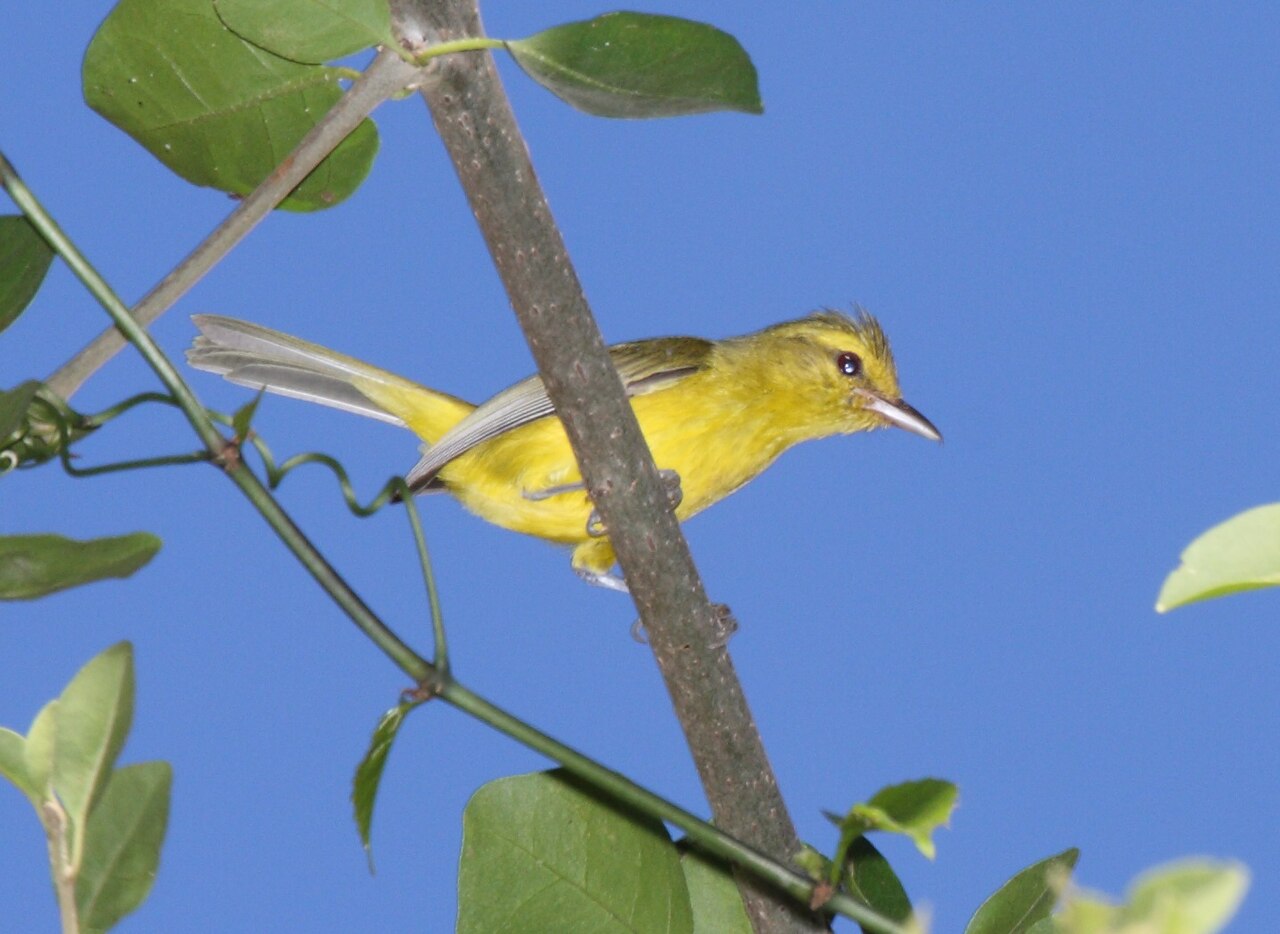
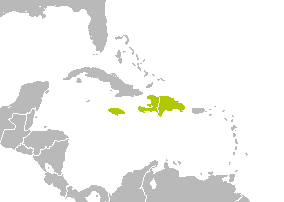
The golden swallow is a swallow endemic to the Caribbean island of Hispaniola and was once native to Jamaica, but is now extirpated there. It is restricted to isolated montane forests that primarily consist of the Hispaniolan pine. This species is considered to be a vulnerable species by the International Union for Conservation of Nature (IUCN). The exact cause of its extirpation from Jamaica is unknown, but likely factors include predation by introduced mammals and habitat loss, although the habitat loss theory is not supported by much evidence. The last sighting of the nominate subspecies was in Hardwar Gap, with three birds being seen on 8 June 1989.
Region
Caribbean (Hispaniola)
Typical Environment
The species occupies isolated montane forests across the high ranges of the Dominican Republic and Haiti, especially in Hispaniolan pine and adjacent cloud forest edges. It prefers open patches, ridgelines, and forest gaps where aerial insects are abundant. Nesting sites include cavities in standing snags, cliffs, and occasionally road cuts or buildings. It avoids dense lowland forests and heavily urbanized areas. Local movements may occur following seasonal insect availability and weather.
Altitude Range
800–2800 m
Climate Zone
Highland
Ease of Keeping
Beginner friendly: 1/5
This iridescent swallow is confined today to the highlands of Hispaniola after being extirpated from Jamaica in the late 20th century. It nests in natural tree cavities, old woodpecker holes, cliffs, and occasionally human structures, favoring Hispaniolan pine forests. Population declines are linked to habitat alteration and introduced predators. Its swift, glittering flight over montane ridges is a hallmark of intact high-elevation pine ecosystems.


The extinct nominate subspecies, T. e. euchrysea

Sketch of the subspecies T. e. sclateri

Adult female T. e. sclateri in hand
Temperament
social and active
Flight Pattern
fast and agile with short rapid wingbeats and brief glides
Social Behavior
Often forages in loose groups and may breed semi-colonially where cavities are abundant. Pairs are typically monogamous during the breeding season. Nests are lined with soft materials and feathers, and both sexes participate in nest defense.
Migratory Pattern
Resident
Song Description
Gives soft twittering chips and liquid trills, often delivered in flight over ridges. Vocalizations are modest in volume but frequent during foraging and near nest sites.
Plumage
Iridescent golden-green to bronze-green upperparts with darker wings and a slightly forked tail; clean white underparts from throat to undertail coverts. The sheen varies with light, giving a rich metallic glow on the head, mantle, and back.
Diet
Feeds almost entirely on aerial insects, including flies, beetles, winged ants, wasps, and other small flying arthropods. It catches prey on the wing using swift, acrobatic chases and occasional sallies from perches. Foraging height varies from canopy level to well above ridgelines, tracking insect swarms. During cool or windy conditions, it concentrates where insects are sheltered or lifted by updrafts.
Preferred Environment
Forages over open montane pine stands, natural clearings, pastures within highland zones, and along cliff faces and road cuts. Also hunts above forest edges and valleys where thermals concentrate insects.