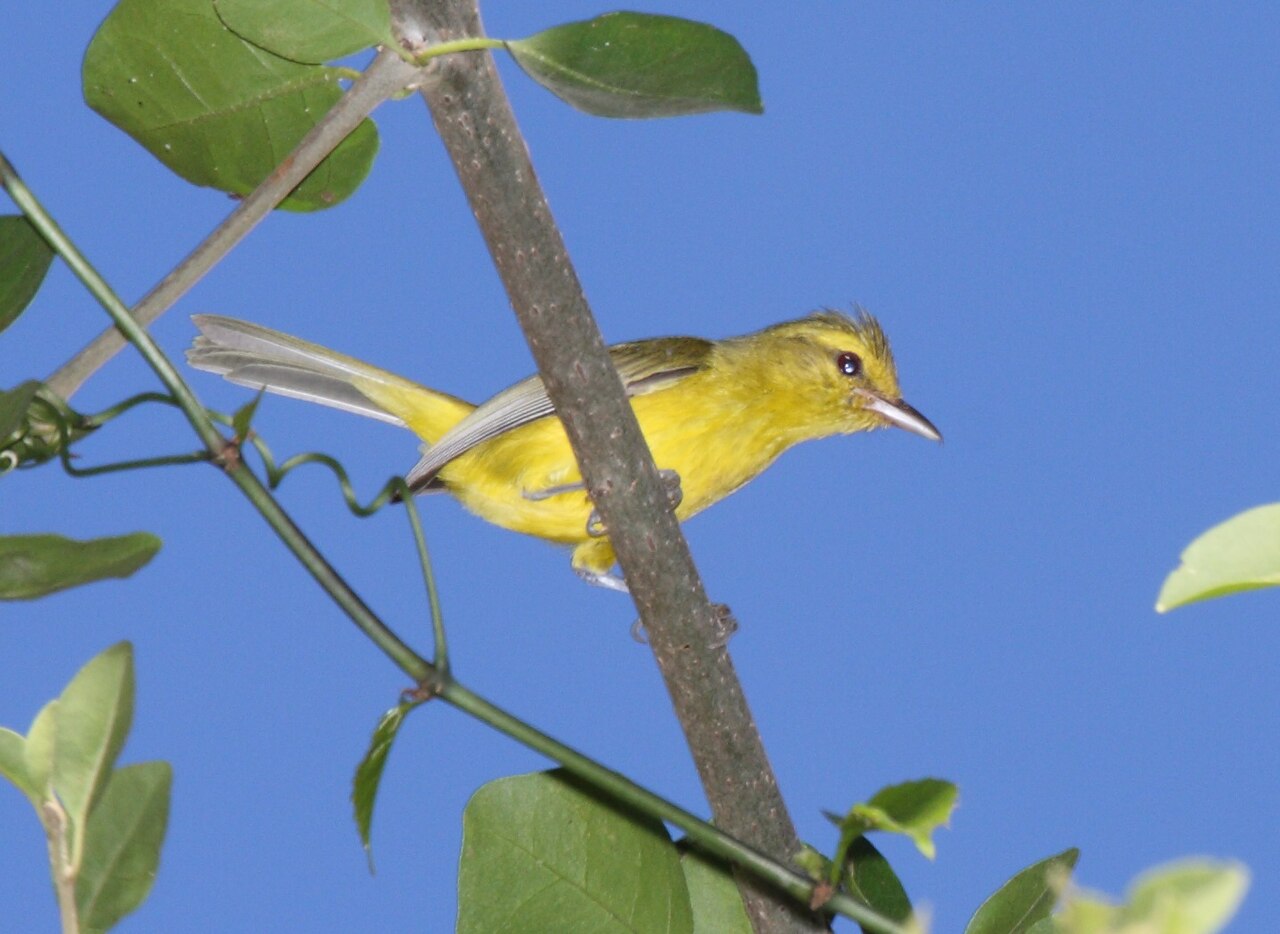
The golden tanager is a species of bird in the family Thraupidae. It is widespread and often common in highland forests of the Andes and Venezuelan Coastal Range in north-western South America.
Region
Andes and Venezuelan Coastal Range
Typical Environment
Found in humid montane and cloud forests from the Venezuelan Coastal Range south through the Andes of Colombia and Ecuador into northern Peru. It frequents forest edges, mature secondary growth, and canopy gaps with fruiting trees. The species is most often encountered in the mid to upper canopy, but will descend to lower strata at forest edges. It commonly travels with mixed flocks of tanagers and other insectivores while foraging along mossy branches and epiphyte-laden limbs.
Altitude Range
600–2700 m
Climate Zone
Highland
Ease of Keeping
Beginner friendly: 1/5
The golden tanager is a striking highland tanager with vivid yellow plumage contrasted by black facial and wing markings. It often joins mixed-species flocks, foraging actively in the mid to upper canopy. Subspecies vary slightly in the extent of black on the back and face across its Andean range. Its preference for humid montane forests makes it sensitive to deforestation but it remains locally common where habitat persists.


Cali, Valle, Colombia
Temperament
social and active
Flight Pattern
short rapid wingbeats
Social Behavior
Frequently joins mixed-species flocks, moving quickly through the canopy in small groups or pairs. Pairs maintain small nesting territories during the breeding season, constructing a small cup nest concealed in dense foliage. Both parents are involved in provisioning the young.
Migratory Pattern
Resident
Song Description
Vocalizations include thin, high-pitched chips and soft twittering phrases delivered from the canopy. Songs are modest and somewhat buzzy, often interspersed with rapid contact calls while flocking.
Plumage
Bright golden-yellow body with contrasting black facial mask and black wings and tail edged with yellow; some subspecies show darker mottling on the mantle.
Diet
Consumes small fruits and berries from trees and shrubs, especially those bearing arillate or soft fruits. Also gleans insects and other arthropods from leaves and twigs, occasionally hawking small flying insects. Will exploit mixed-species flock activity to flush prey and locate fruiting trees. May sip nectar opportunistically.
Preferred Environment
Forages primarily in the mid to upper canopy of humid montane forest, at edges, and along forested ridges. Often concentrates at fruiting trees and along sunlit gaps where insects are more active.