The Fiordland penguin, also known as the Fiordland crested penguin, is a crested penguin species endemic to New Zealand. It currently breeds along the south-western coasts of New Zealand's South Island as well as on Stewart Island/Rakiura and its outlying islands. Because it originally ranged beyond Fiordland, it is sometimes referred to as the New Zealand crested penguin. It is occasionally found in Australia.
Region
Southwest New Zealand
Typical Environment
Breeding occurs along the remote, forested coastline of Fiordland on the South Island, as well as on Stewart Island/Rakiura and nearby outlying islands. They prefer secluded, shaded nest sites under tree roots, flax, or in coastal caves above rocky shores. At sea, they forage in cool coastal waters over the continental shelf and inshore pelagic zones. Birds occasionally wander to Tasmania and southern Australia, especially outside the breeding period.
Altitude Range
Sea level to 200 m
Climate Zone
Temperate
Ease of Keeping
Beginner friendly: 1/5
The Fiordland penguin, or Fiordland crested penguin, breeds in dense temperate rainforest and rocky coastal caves of southwestern New Zealand and nearby islands. Adults lay two eggs but typically raise only one chick, a common strategy among crested penguins. They are shy and secretive on land, often nesting under thick vegetation or boulders. Outside the breeding season they disperse widely at sea.


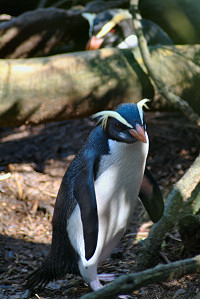
The Fiordland penquin has a prominent yellow crest on its head
Temperament
secretive on land; assertive around nest sites
Flight Pattern
flightless; powerful underwater swimmer
Social Behavior
Breeds in small, loose colonies or scattered pairs hidden in forest or rocky crevices. Typically monogamous within a season, with elaborate mutual displays at the nest. Two eggs are laid but the smaller first egg rarely results in a fledged chick; usually one chick is raised. Both parents share incubation and chick-rearing duties.
Migratory Pattern
Seasonal migrant
Song Description
At colonies they give loud braying and barking calls, along with throaty trumpeting during displays. Partners exchange duet-like contact calls to maintain pair bonds and locate each other in dense cover.
Plumage
Glossy black to slate upperparts with clean white underparts; dense, waterproof plumage adapted for diving. Broad yellow superciliary crests sweep back over the head with drooping plumes. Face and throat are dark with a sharp contrast to the white belly.
Diet
Feeds mainly on small fish, squid, and krill-like crustaceans. Diet composition varies seasonally with prey availability near the continental shelf. They pursue prey underwater using rapid, agile swimming and short, repeated dives.
Preferred Environment
Forages in inshore and near-shelf waters, often around kelp beds and rocky headlands. During breeding, most foraging occurs relatively close to colonies, expanding farther offshore post-breeding.