

The Eurasian treecreeper or common treecreeper is a small passerine bird also known in the British Isles, where it is the only living member of its genus, simply as treecreeper. It is similar to other treecreepers, and has a curved bill, patterned brown upperparts, whitish underparts, and long stiff tail feathers which help it creep up tree trunks. It can be most easily distinguished from the similar short-toed treecreeper, which shares much of its European range, by its different song.
Region
Palearctic (Europe and northern Asia)
Typical Environment
Found widely across boreal, temperate, and montane forests, favoring mature coniferous and mixed woodlands with rough-barked trees. It also occurs in old deciduous parks, orchards, and well-wooded gardens. Prefers trunks and large branches where bark fissures are abundant, avoiding smooth-barked trees when possible. Northern and high-altitude birds may shift southward or downslope in winter, while many central and western European populations are resident.
Altitude Range
Sea level to 3000 m
Climate Zone
Temperate
Ease of Keeping
Beginner friendly: 1/5
A specialist bark forager, it uses a fine downcurved bill to probe into crevices while bracing itself with stiff tail feathers. Unlike nuthatches, it almost always creeps upward and then flies to the base of another trunk to start again. It nests behind loose bark or in narrow crevices, often lining the cup with feathers. It is best separated from the Short-toed Treecreeper by its higher, more musical song and slightly colder-toned plumage.


A Eurasian treecreeper climbing up a tree, leaning on its tail
Short-toed treecreeper, a confusion species in Europe

Central European bird feeding on a trunk

Introduced redwoods are the preferred nesting trees where present.


Formica rufa, a competitor for arthropod prey

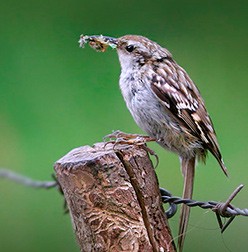
The claws of the treecreeper allows it to attach to the trunks and branches.
Temperament
solitary and unobtrusive
Flight Pattern
short rapid wingbeats between trees
Social Behavior
Typically seen alone or in pairs, especially during the breeding season when it defends a small territory. Nests are tucked behind loose bark or in narrow crevices, constructed from twigs, bark strips, and lined with feathers. In winter it may join mixed-species foraging flocks and occasionally roost communally in cold snaps.
Migratory Pattern
Partial migrant
Song Description
A high, thin, and musical series that rises then falls, often rendered as a delicate tinkling phrase. Calls are sharp, high tsii notes used while foraging and keeping contact.
Plumage
Upperparts mottled and streaked brown with buff and whitish scalloping; underparts clean whitish. Long, stiff tail feathers aid climbing; fine, downcurved bill.
Diet
Primarily small arthropods such as beetles, aphids, larvae, and spiders gleaned from bark crevices. It probes with its slender bill, flicking aside lichens and scales to reach hidden prey. In harsher winters it may take seeds or visit feeders for suet and fat, but animal prey remains dominant.
Preferred Environment
Forages almost exclusively on tree trunks and large branches, starting low and spiraling upward. Prefers rough, fissured bark of conifers and mature deciduous trees where invertebrates are most abundant.


