

The Eurasian wren or northern wren is a very small insectivorous bird and the only member of the wren family found in the Old World, specifically in Eurasia and Africa (Maghreb). In Anglophone Europe, it is commonly known simply as the wren. It has a very short tail which is often held erect, a short neck and a relatively long thin bill. It is russet brown above, paler buff-brown below and has a cream buff supercilium. The sexes are alike.
Region
Palearctic (Europe, North Africa, and temperate Asia)
Typical Environment
Common across woodland undergrowth, hedgerows, scrub, and gardens from the Atlantic coasts of Europe to East Asia. Prefers dense, tangled cover near the ground, including bramble patches, fallen logs, stone walls, and brush piles. Occurs along streams and wet thickets but also uses dry scrub, coastal cliffs with vegetation, and mountain forests up to the tree line. In urban areas it frequents parks, allotments, and overgrown corners with thick ground cover.
Altitude Range
Sea level to 3000 m
Climate Zone
Temperate
Ease of Keeping
Beginner friendly: 1/5
Despite its tiny size, the Eurasian wren delivers an exceptionally loud, rapid song that carries through dense cover. Males often build several 'cock nests' within their territory, with the female choosing one to line and use. In harsh winters, wrens sometimes roost communally in cavities to conserve heat.


Eurasian wren in Germany

Juvenile Eurasian wren in Norway

![Subspecies Troglodytes troglodytes nipalensis with its very dark plumage in Sikkim, India[21]](https://upload.wikimedia.org/wikipedia/commons/thumb/f/f7/Eurasian_Wren_Pangolakha_Wildlife_Sanctuary_East_Sikkim_India_20.10.2015.jpg/500px-Eurasian_Wren_Pangolakha_Wildlife_Sanctuary_East_Sikkim_India_20.10.2015.jpg)
Subspecies Troglodytes troglodytes nipalensis with its very dark plumage in Sikkim, India[21]

Eggs of the subspecies T. t. kabylorum - MHNT

Cuculus canorus canorus in a spawn of Troglodytes troglodytes - MHNT
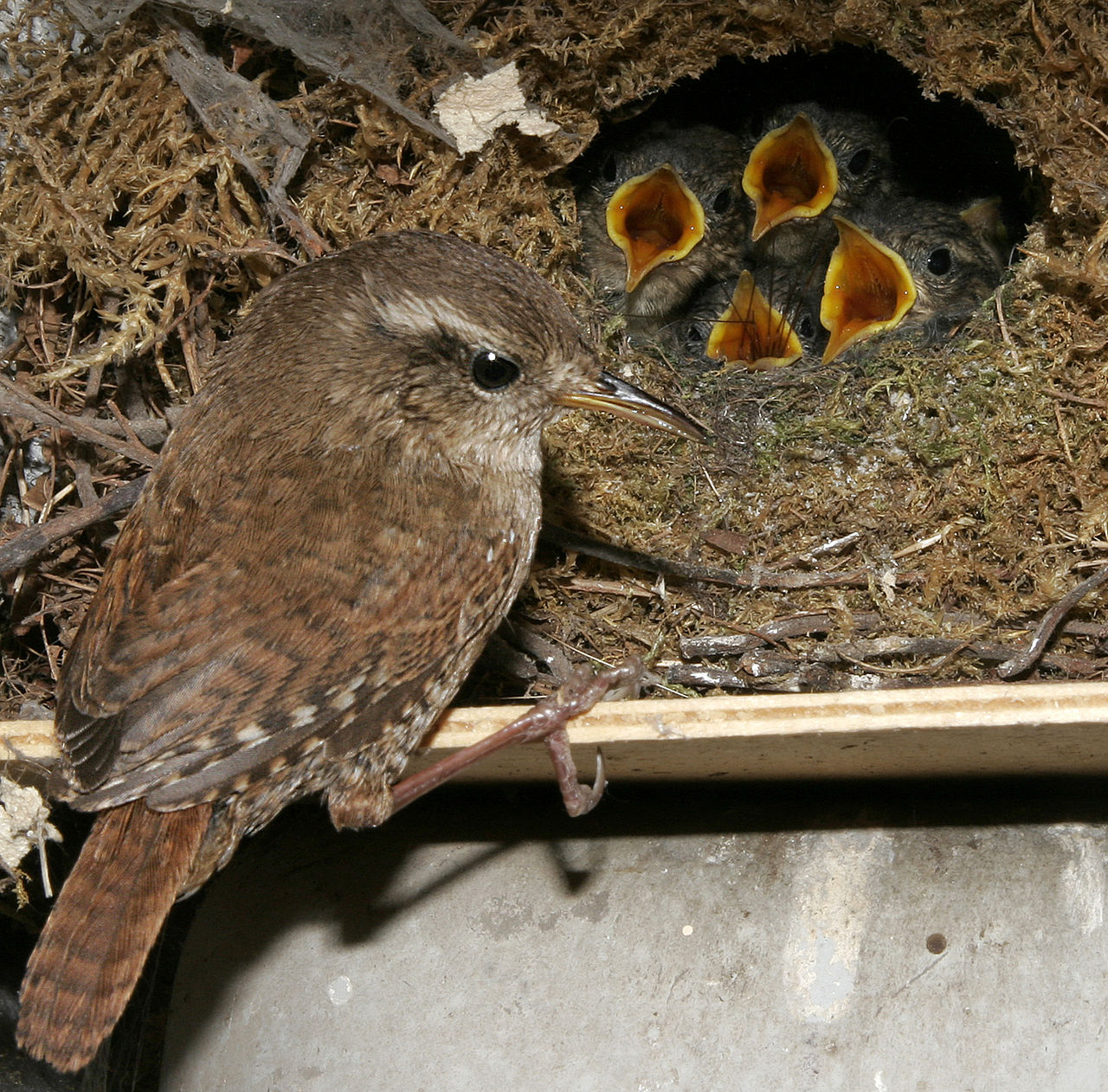
Adult with four hatchlings; one has just been fed a spider or harvestman

Wren on a British farthing coin

Wrens on a stamp from the Faroe Islands
Temperament
secretive and active
Flight Pattern
short rapid wingbeats with low, bouncing flights
Social Behavior
Primarily solitary and strongly territorial during the breeding season. Males may build multiple nests within their territory; the female selects one to line and use. Nests are placed in crevices, banks, roots, or among dense vegetation; the female incubates and both parents typically feed the young.
Migratory Pattern
Partial migrant
Song Description
A loud, explosive series of rapid trills and rattling phrases delivered at high speed, far carrying for such a small bird. Calls include sharp ticks and chatters, with scolding rattles when alarmed.
Plumage
Fine, barred russet-brown upperparts with paler buff underparts and subtle darker barring on flanks and tail; short rounded wings and a tiny, often up-cocked tail.
Diet
Feeds mainly on small insects, spiders, and other arthropods gleaned from leaf litter, bark crevices, roots, and mossy stones. Probes with its slender bill into gaps and under debris, often flicking its wings and tail as it forages. In winter it may take small berries or seeds opportunistically when invertebrates are scarce.
Preferred Environment
Forages close to the ground in dense undergrowth, tangled scrub, and along stream banks. Frequently searches among fallen logs, rock piles, ivy, and stone walls, as well as thick garden vegetation.


