

The Eurasian magpie or common magpie is a resident breeding bird throughout the northern part of the Eurasian continent. It is one of several birds in the crow family (corvids) designated magpies, and belongs to the Holarctic radiation of "monochrome" magpies. In Europe, "magpie" is used by English speakers as a synonym for the Eurasian magpie: the only other magpie in Europe is the Iberian magpie, which is limited to the Iberian Peninsula. Despite having a shared name and similar colouration, it is not closely related to the Australian magpie.
Region
Palearctic (Europe and temperate Asia)
Typical Environment
Widespread across most of Europe and large parts of temperate Asia, absent only from the far north and some islands. It thrives in mosaic landscapes with scattered trees, hedgerows, and open ground. Common in agricultural areas, suburbs, parks, and woodland edges, and it readily adapts to human-modified environments. Avoids dense, unbroken forests and true deserts but occupies a broad range of semi-open habitats.
Altitude Range
Sea level to 2500 m
Climate Zone
Temperate
Ease of Keeping
Beginner friendly: 1/5
Eurasian magpies are exceptionally intelligent corvids known for problem-solving, tool use, and complex social behavior. They have iridescent plumage that appears blue-green in good light despite looking black at a distance. They cache food and remember hundreds of hiding spots, and they build large, domed stick nests. Their bold, inquisitive nature often brings them into close contact with humans in parks and farmlands.


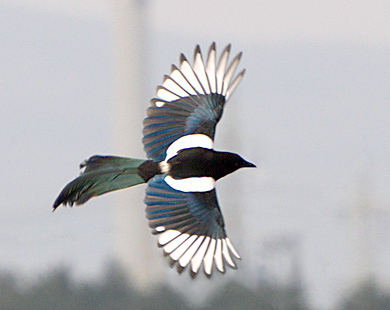


P. p. bactriana in Ladakh
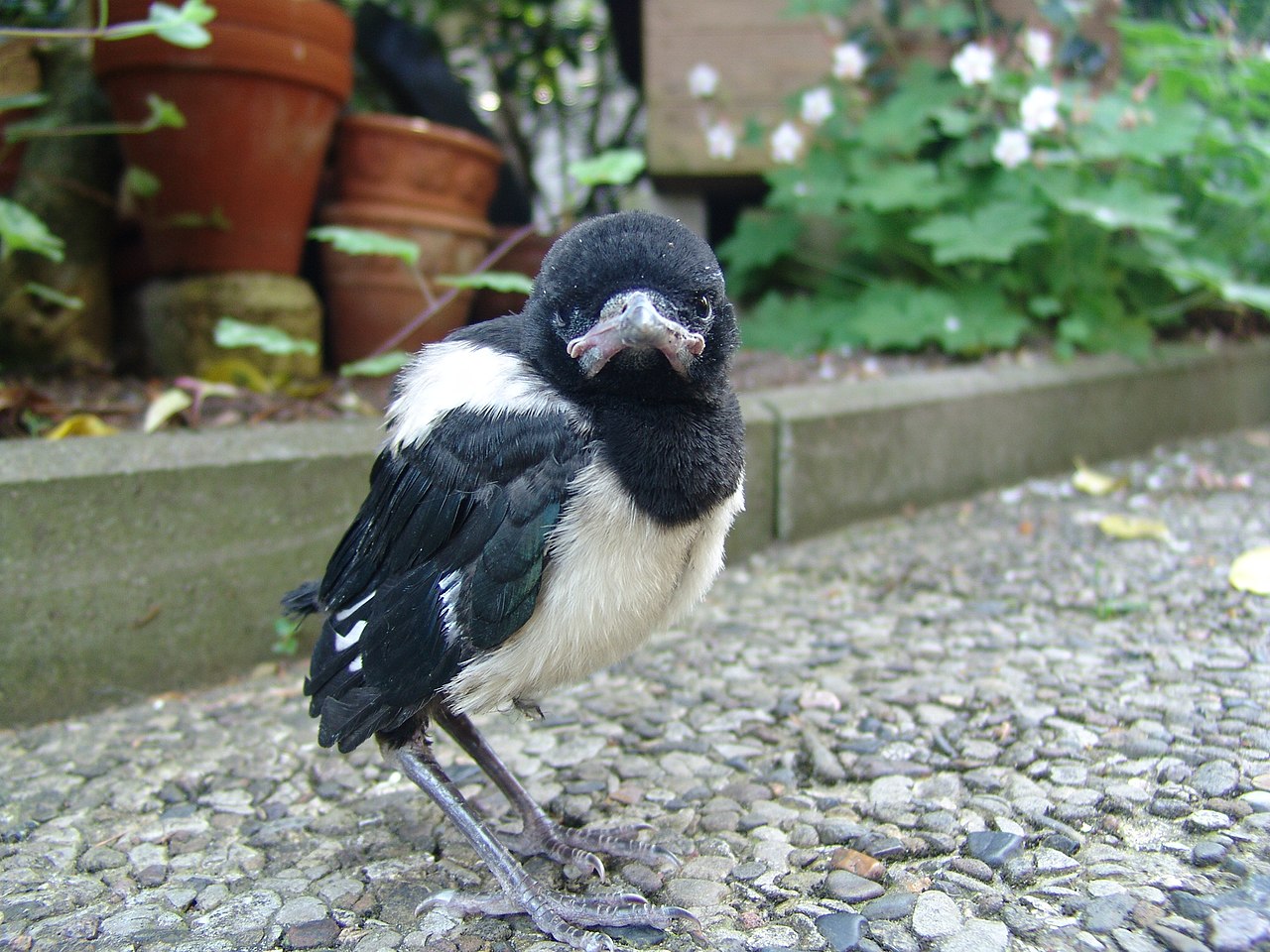
A recently fledged magpie

Eurasian magpie egg

Pica pica pica - (MHNT)

Magpie nest.

A nest made by Eurasian magpie.

Hopscotch game in England with the magpie rhyme.
Temperament
bold, intelligent, and territorially assertive in breeding season
Flight Pattern
short rapid wingbeats interspersed with brief glides; slightly undulating
Social Behavior
Pairs maintain territories during the breeding season and construct large, domed stick nests in trees or tall shrubs. Outside of breeding, they often form loose flocks and communal roosts. They are monogamous, with both sexes participating in nest building and provisioning.
Migratory Pattern
Partial migrant
Song Description
Vocalizations are loud, harsh, and chattering, often rendered as chack-chack-chack and rattling series. They also produce softer contact notes and a variety of scolds and buzzes depending on context.
Plumage
Glossy black with strong iridescent blue-green sheen on wings and tail, contrasting with clean white scapulars, belly, and primaries.
Diet
An opportunistic omnivore, it eats insects and other invertebrates, small vertebrates, eggs and nestlings, carrion, grains, fruits, and human food scraps. It frequently scavenges but also actively hunts small prey on the ground. Food caching is common, with items hidden and later retrieved using spatial memory. Diet composition shifts seasonally with availability.
Preferred Environment
Typically forages on the ground in open fields, pastures, and lawns, often near hedgerows and scattered trees for cover. It exploits urban parks, gardens, and refuse sites, showing high adaptability. Edge habitats with good visibility and nearby perches are preferred.


