The eastern screech owl or eastern screech-owl is a small owl that is relatively common in Eastern North America, from Mexico to Canada. This species resides in most types of woodland habitats across its range, and is relatively adaptable to urban and developed areas compared to other owls. Although it often lives in close proximity to humans, the eastern screech owl frequently avoids detection due to its strictly nocturnal habits.
Region
Eastern North America
Typical Environment
Found from southern Canada through the eastern and central United States into northeastern Mexico. It occupies deciduous and mixed woodlands, riparian corridors, orchards, shelterbelts, and urban parks. The species favors areas with mature trees that provide natural cavities or nest boxes. It adapts well to human-altered landscapes provided some tree cover remains. Avoids extensive treeless grasslands and the densest boreal forests.
Altitude Range
Sea level to 1800 m
Climate Zone
Temperate
Ease of Keeping
Beginner friendly: 1/5
This small owl has two main color morphs—gray and rufous—both superbly camouflaged against tree bark. It readily uses nest boxes and often lives unnoticed in suburban neighborhoods and city parks. Its voice is a soft descending whinny and a tremolo trill rather than a classic hoot. Adults regurgitate indigestible pellets that can reveal their recent diet.


Illustration of the eastern screech owl by Audubon

Eastern screech owl (gray morph) in Canada

The eastern screech owl can easily avoid detection during the day due to its effective camouflage among the bark of deciduous trees.
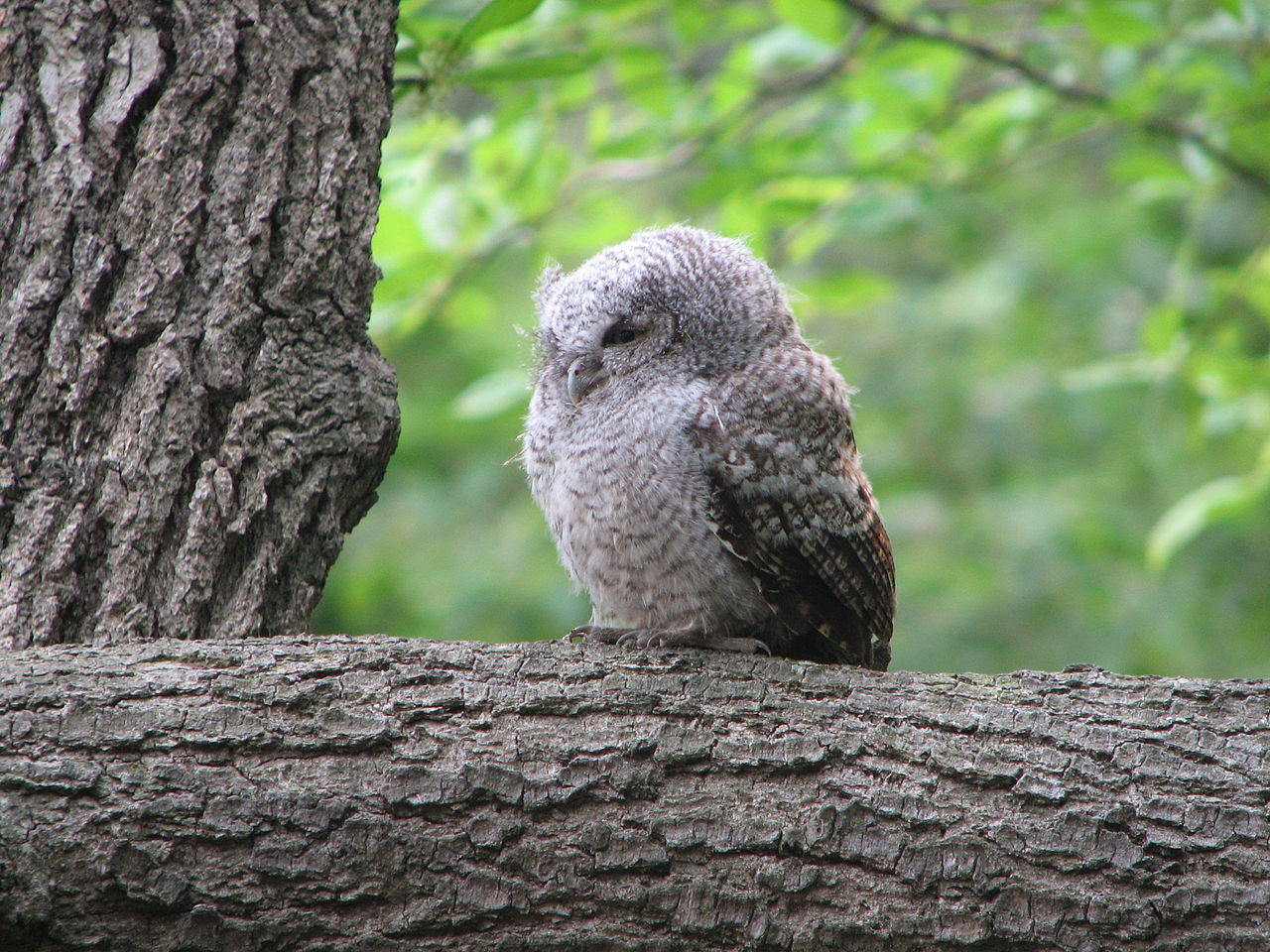
Juvenile eastern screech owl

Fuertes portrait of a red and gray morph eastern screech owl


Temperament
solitary and territorial
Flight Pattern
silent flight with short glides and rapid wingbeats
Social Behavior
Generally monogamous and nests in tree cavities, woodpecker holes, or nest boxes. Females incubate while males provision them and later the chicks. Pairs defend small territories and may reuse nest sites across years. Outside the breeding season they remain solitary and secretive.
Migratory Pattern
Resident
Song Description
A soft, descending whinny used in territorial and pair communication, often likened to a horse’s whinny. Also gives an even-pitched tremolo or trill that accelerates slightly. Calls are subdued but carry well on calm nights.
Plumage
Cryptically mottled and streaked with complex bark-like patterning; occurs in gray and rufous morphs, sometimes intermediate. Compact, broad-headed owl with prominent ear tufts and a well-defined facial disk. Underparts are streaked and barred; upperparts are heavily mottled.
Diet
Opportunistic predator taking small mammals, small birds, large insects, spiders, earthworms, and occasionally reptiles and amphibians. Hunts from low to mid-level perches, pouncing to the ground or snatching prey from foliage. Swallows small prey whole and coughs up pellets with bones, fur, and insect parts. Diet composition shifts seasonally, with more insects in warm months.
Preferred Environment
Feeds along woodland edges, hedgerows, and riparian corridors where cover and open foraging spaces meet. In towns, it hunts around streetlights that attract insects and near bird feeders that attract small mammals and birds. Requires perches with good concealment and nearby cavities for day roosting.