

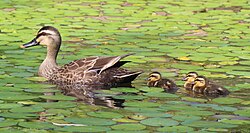
The eastern spot-billed duck or Chinese spot-billed duck is a species of dabbling duck that breeds in East and Southeast Asia. This species was formerly considered a subspecies of the Indian spot-billed duck and both were referred to as the spot-billed duck. The name is derived from the yellow spot on the bill.
Region
East and Southeast Asia
Typical Environment
Breeds from the Russian Far East and northeastern China through Korea and much of Japan, with wintering birds moving south into southern China, Taiwan, and northern mainland Southeast Asia. It frequents shallow freshwater lakes, slow rivers, marshes, reservoirs, and flooded fields, especially rice paddies. In cities it adapts well to parks and ornamental ponds. During winter it may also use estuaries and sheltered coastal lagoons.
Altitude Range
0–2000 m
Climate Zone
Temperate
Ease of Keeping
Beginner friendly: 3/5
The eastern spot-billed duck is a common dabbling duck of East and Southeast Asia, often seen in rice paddies and urban parks. It was formerly treated as a subspecies of the Indian spot-billed duck but is now recognized as a distinct species. It can hybridize with mallards in parts of its range, which sometimes complicates identification. Its name comes from the bright yellow tip and spots on its otherwise dark bill.


Showing blue speculum

Taking off

Temperament
social and wary, but tolerant in parks
Flight Pattern
fast, direct flight with rapid wingbeats
Social Behavior
Forms pairs in the breeding season and small to large flocks outside it. Nests are placed on the ground near water, hidden in dense vegetation. Clutches typically contain several creamy white eggs, and both adults are attentive around brood-rearing areas.
Migratory Pattern
Partial migrant
Song Description
Females give loud nasal quacks reminiscent of mallards, often in series. Males produce softer rasping notes and low whistles during displays.
Plumage
Overall mottled brown body with pale-edged feathers giving a scaly look; darker crown and nape with paler cheeks; iridescent green speculum with narrow white borders.
Diet
Feeds mainly by dabbling and upending, taking seeds and shoots of aquatic plants, grasses, and agricultural grains like rice. It also consumes aquatic insects, snails, small crustaceans, and other invertebrates. Foraging is flexible and adjusts to seasonal availability, with more animal matter taken in the breeding season.
Preferred Environment
Shallow wetlands, marsh edges, flooded fields, and calm backwaters where it can reach submerged vegetation. In human-dominated landscapes it forages readily in rice paddies and urban ponds.


