
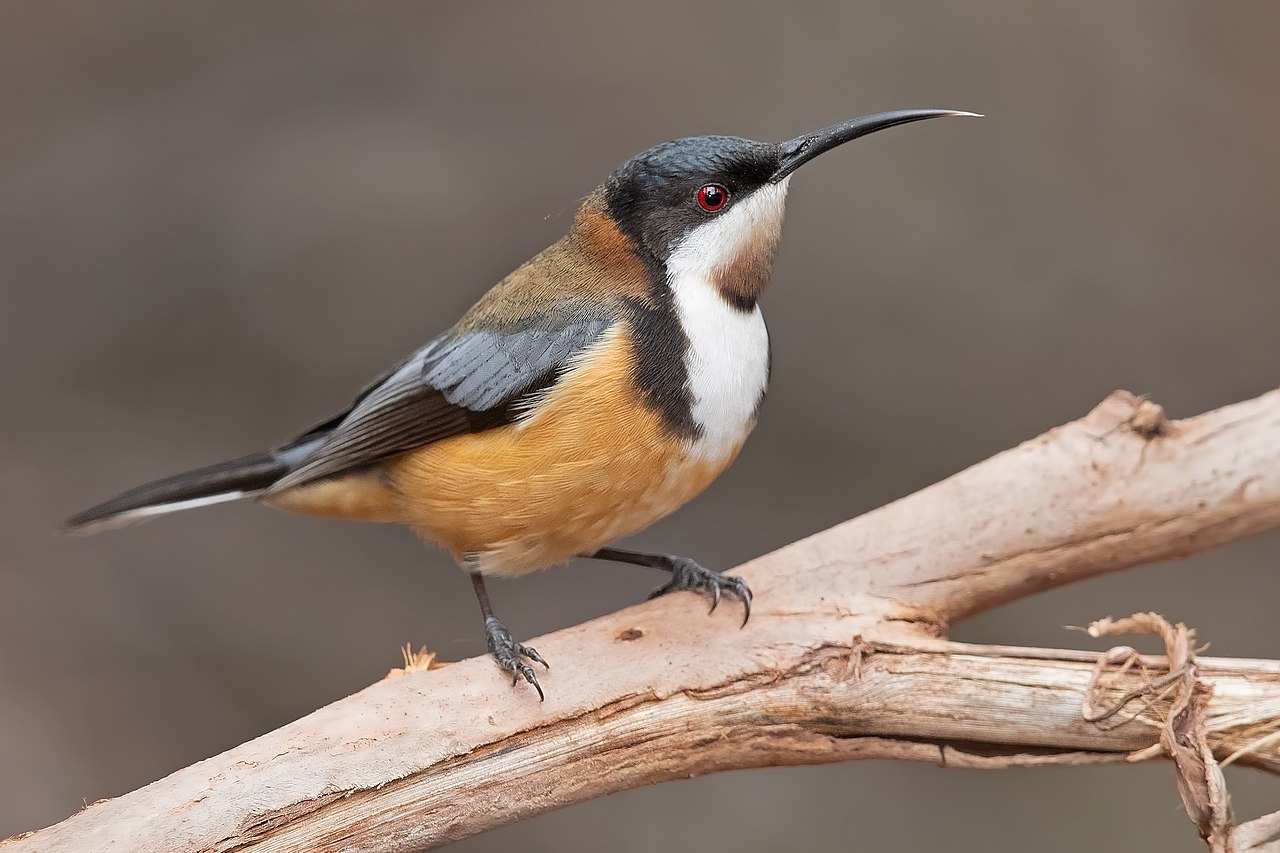
The eastern spinebill is a species of honeyeater found in south-eastern Australia in forest and woodland areas, as well as gardens in urban areas of Canberra, Sydney, Melbourne, Adelaide and Hobart. It is around 15 cm long, and has a distinctive black, white and chestnut plumage, a red eye, and a long downcurved bill.
Region
Southeast Australia
Typical Environment
Found from coastal and upland areas of eastern and southeastern Australia, including Tasmania, extending through New South Wales, the ACT, Victoria and into southeastern South Australia. Occupies eucalypt forests, open woodlands, heathlands, and coastal scrub, as well as urban parks and gardens where nectar-rich shrubs are available. Frequently follows flowering events of native shrubs and trees and may move altitudinally between seasons. In cities it is a regular visitor to Grevillea and Correa plantings and can persist in small green spaces.
Altitude Range
Sea level to 1800 m
Climate Zone
Temperate
Ease of Keeping
Beginner friendly: 1/5
A swift, agile honeyeater, the eastern spinebill can hover briefly like a hummingbird to sip nectar from tubular flowers. It is an important pollinator of native plants such as Correa, Banksia and Grevillea, and adapts readily to flowering garden shrubs. Individuals make local movements tracking blooms and can appear in large numbers when nectar is abundant. Despite its small size, it can be quite assertive around rich nectar sources.


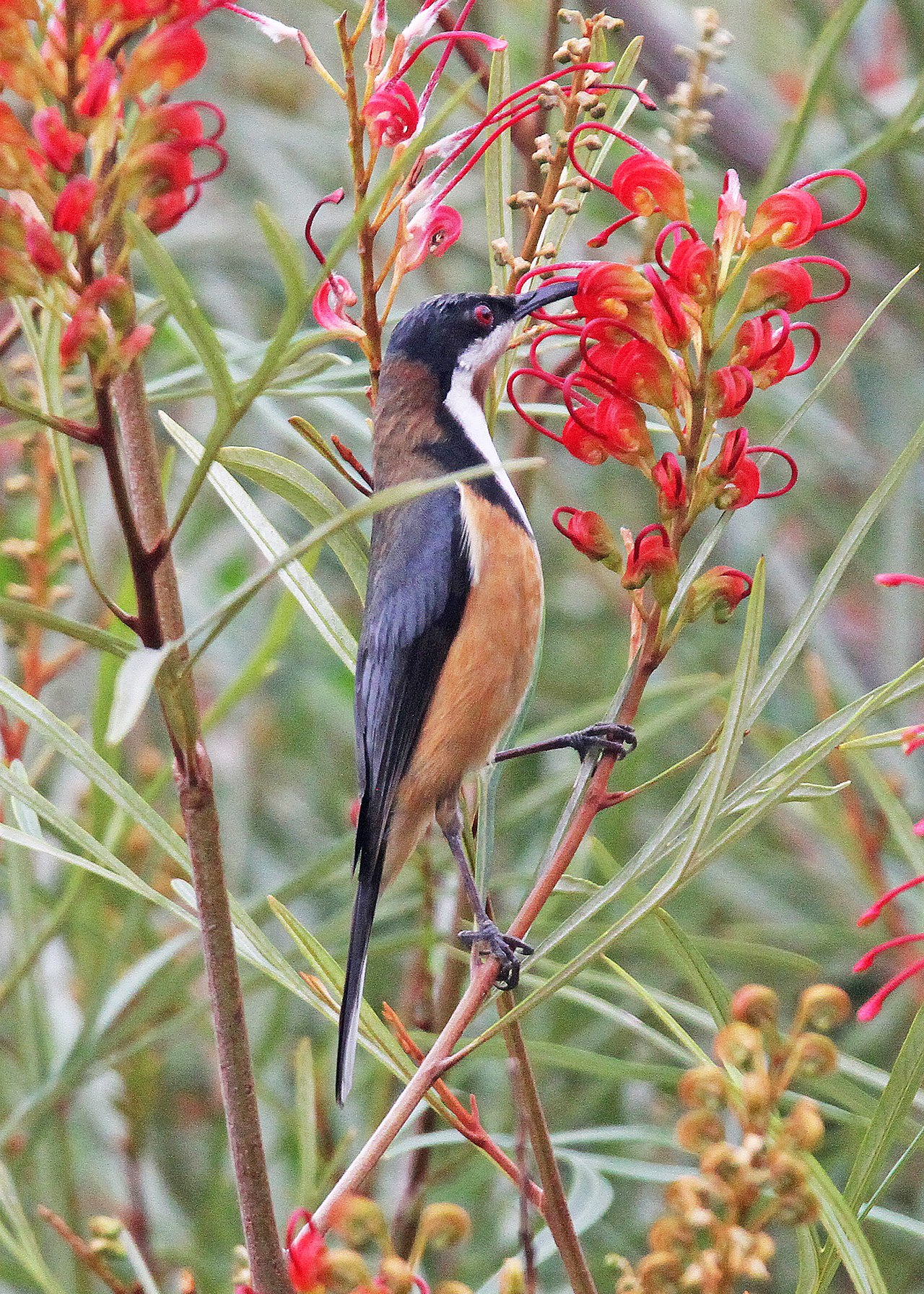
Eastern spinebill feeding on the nectar of a Grevillea flower in Lamington National Park, Queensland, Australia
Temperament
active and territorial around nectar sources
Flight Pattern
short rapid wingbeats; capable of brief hovering
Social Behavior
Typically seen singly or in pairs; forms small loose groups where flowers are abundant. During the breeding season, pairs defend feeding and nesting areas. The neat cup nest is placed in dense shrubs; the female usually builds and incubates, with both parents feeding the young.
Migratory Pattern
Partial migrant
Song Description
A high, piping series of thin, sweet whistles interspersed with rapid tinkling notes. Calls are sharp and metallic, often given in quick bursts while foraging among flowering shrubs.
Plumage
Crisp, contrasting pattern with a white throat sharply bordered by black, rich chestnut on the breast and flanks, and grey-brown back and wings.
Diet
Feeds primarily on nectar from native flowering plants such as Correa, Banksia, Grevillea, and eucalypts, using its slender decurved bill and brush-tipped tongue. Supplements its diet with small insects and spiders, gleaned from foliage or hawked on the wing, especially when feeding nestlings. Will also use nectar from exotic garden cultivars when available.
Preferred Environment
Forages in the understory to mid-canopy of forests, woodlands, and coastal heath, concentrating where shrubs are in bloom. In urban areas it frequents gardens and parks with dense, flowering plantings and sheltering shrubs.


