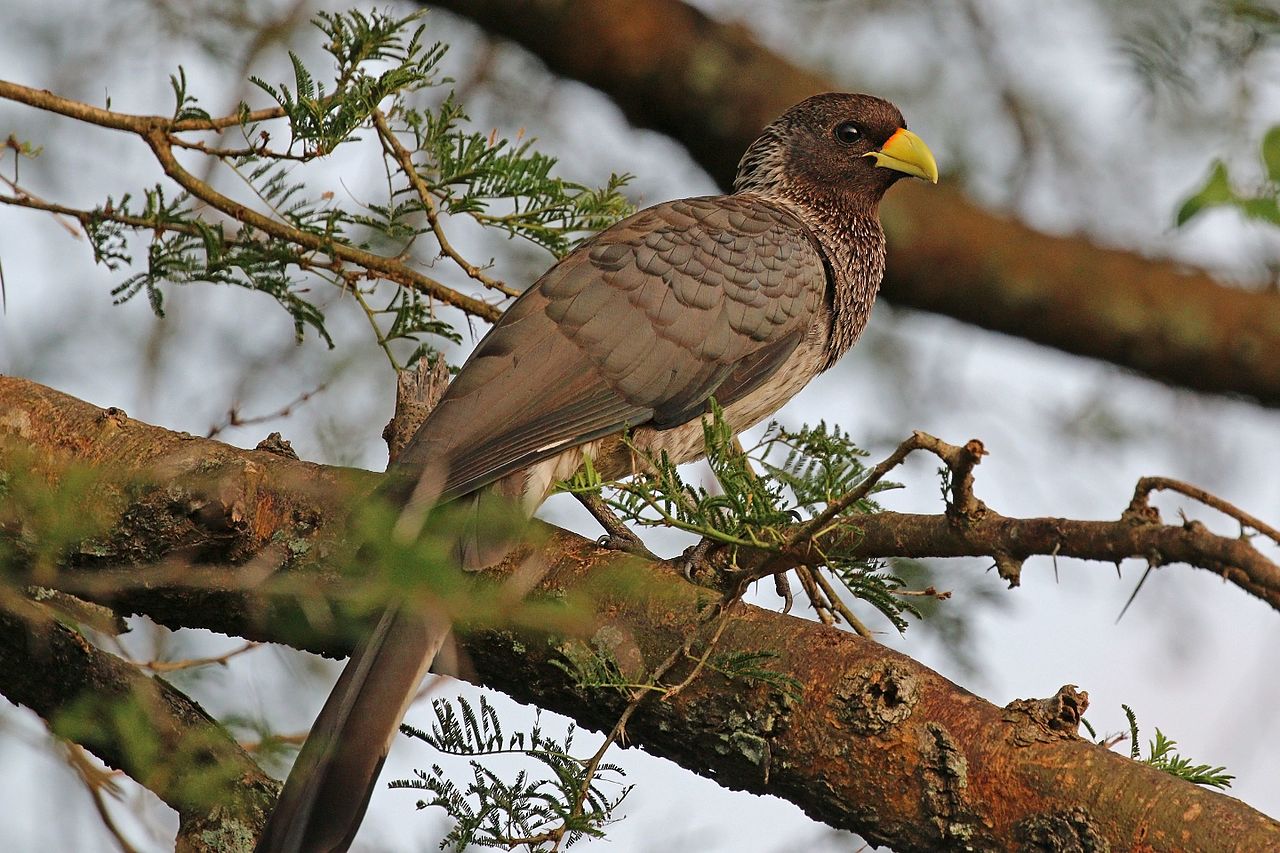
The eastern nicator is a species of songbird in the family Nicatoridae. It is found in Eswatini, Kenya, Malawi, Mozambique, Somalia, South Africa, Tanzania, Zambia, and Zimbabwe. Its natural habitats are subtropical or tropical dry forests, dry savanna, and subtropical or tropical moist shrubland. It occurs south to around Mtunzini in northern KwaZulu-Natal, South Africa, and is regularly reported from lowland areas north through to east Africa, including inland areas along the Zambezi River.
Region
East and Southern Africa
Typical Environment
Occurs from coastal Somalia and Kenya south through Tanzania and Mozambique to northern KwaZulu-Natal in South Africa, with inland populations along the Zambezi system in Malawi, Zambia, and Zimbabwe, and into Eswatini. It favors lowland and foothill habitats, especially dense woodland, riverine forest, thickets, and well-vegetated edges. It also uses secondary growth, forest patches, and overgrown gardens with tangled understory. Presence is often detected by voice rather than sight due to its secretive habits.
Altitude Range
Sea level to 1500 m
Climate Zone
Subtropical
Ease of Keeping
Beginner friendly: 1/5
The Eastern nicator is a robust, thrush-sized songbird of dense thickets and riverine woodland, notable for its loud, melodious whistles and complex duets. Despite its powerful voice, it is often skulking and hard to see, moving through tangles and mid-canopy foliage. It belongs to the small African family Nicatoridae, distinct from shrikes and bulbuls though it may resemble them superficially.


Temperament
secretive and territorial
Flight Pattern
short rapid wingbeats between cover
Social Behavior
Usually solitary or in pairs within well-defined territories. Pairs often duet, especially at dawn, and remain in dense cover while foraging. Nests are typically cup-shaped and placed low to mid-level in thick vegetation.
Migratory Pattern
Resident
Song Description
A rich series of loud, fluty whistles and ringing phrases, often given antiphonally by a pair. Calls may include churring or scolding notes; the song carries far through woodland and thicket.
Plumage
Olive-green upperparts with yellow to yellow-olive underparts; throat often paler with fine streaking; overall sleek but with a robust, shrike-like silhouette.
Diet
Feeds primarily on insects and other arthropods gleaned from foliage and twigs, including caterpillars, beetles, and spiders. Also takes small fruits and berries, especially when insect prey is less abundant. Occasionally hawks short distances for flying insects and may probe leaf clusters for hidden prey.
Preferred Environment
Forages in dense thickets, riverine woodland, and forest edges, mainly in the mid-story and understory. Often works along vine tangles and overgrown secondary growth, sometimes venturing into well-vegetated gardens.