

The Drakensberg prinia or saffron-breasted prinia is a small passerine bird. It lives in eastern South Africa and Eswatini.
Region
Drakensberg Mountains
Typical Environment
Found along the Drakensberg and adjacent eastern escarpment from eastern South Africa into Eswatini, with occurrences in Lesotho. It favors rocky slopes, bracken-covered hillsides, protea and heath scrub, and rank grass with scattered shrubs. The species is most common where shrubby cover breaks up open montane grassland, often near stream gullies. It is generally sedentary, remaining within established territories throughout the year.
Altitude Range
900–2600 m
Climate Zone
Highland
Ease of Keeping
Beginner friendly: 1/5
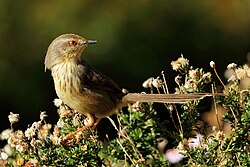
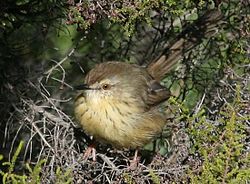
Also called the saffron-breasted prinia, this small warbler is a specialist of montane grasslands and shrublands of the Drakensberg. It often holds its long, graduated tail cocked and flicking while moving through low bushes. Pairs defend territories year-round and give persistent trills from prominent perches. Its nest is a neat, purse-like structure placed low in grasses or shrubs.



Temperament
active and somewhat skulking
Flight Pattern
short rapid wingbeats with low, bouncing flights between shrubs
Social Behavior
Usually encountered in pairs or small family groups that defend territories year-round. Monogamous pairs build a neat, pendant or purse-like nest low in grasses or shrubs. Both parents incubate and feed the young, keeping close to dense cover.
Migratory Pattern
Resident
Song Description
A rapid, buzzy trill and tinkling series delivered repeatedly from exposed perches. Calls include sharp chips and scolding rattles when alarmed. The song often accelerates and can carry across grassy slopes.
Plumage
Upperparts brown to olive-brown with fine streaking; underparts rich saffron-yellow to yellow, paler on the throat. Long, graduated tail often held cocked with contrasting pale tips. Subtle pale supercilium and fine, slender bill typical of prinias.
Diet
Primarily consumes small insects and other arthropods, including beetles, caterpillars, spiders, and flies. It gleans prey from leaves, stems, and grass heads, and occasionally makes short sallies to catch flying insects. Foraging is methodical, moving through low vegetation while flicking the tail.
Preferred Environment
Feeds in dense grass tussocks, bracken, heath, and shrub thickets along rocky slopes and stream margins. Often uses ecotones where shrubs meet open grassland for cover and foraging.


