

The crested eagle is a large Neotropical eagle, and the only member of the genus Morphnus. The crested eagle can grow up to 89 cm (35 in) long, with a wingspan up to 176 cm (69 in), and weigh up to 3 kg (6.6 lb). The plumage varies between a light brownish-gray to sooty gray or even blackish in some cases. It has a white throat and a dark spot on the crest and a small dark mask across the eyes. It ranges extensively throughout Central and South America, but not in large numbers. favoring tropical lowland forest. A powerful predator, its diet consist mainly of small mammals, rodents, snakes and smaller birds. Despite their large distribution, they are currently classified as Near Threatened by the IUCN, due mainly to habitat loss
Region
Central and South America (Neotropics)
Typical Environment
Occurs patchily from southeastern Mexico through Central America into much of the Amazon Basin and the Guianas, with local occurrences in the Atlantic Forest. Strongly tied to extensive primary lowland rainforest and tall, continuous canopy. Often found near rivers, swamps, and forest edges but rarely ventures into open country. Generally scarce and elusive, more often detected by call than by sight. Sensitive to fragmentation and human disturbance, it requires large tracts of intact forest.
Altitude Range
Sea level to 1500 m
Climate Zone
Tropical
Ease of Keeping
Beginner friendly: 1/5
The crested eagle is the sole member of the genus Morphnus and a secretive raptor of the Neotropical lowland forests. It sports a distinctive erect crest and a dark facial mask that contrast with a pale throat. Highly sensitive to forest loss, it persists at low densities across a wide range. Its long nesting cycle and large territories make population recovery slow where habitat is degraded.


Juvenile in Darién, Panama

Illustration of the foot and talons of a crested eagle.
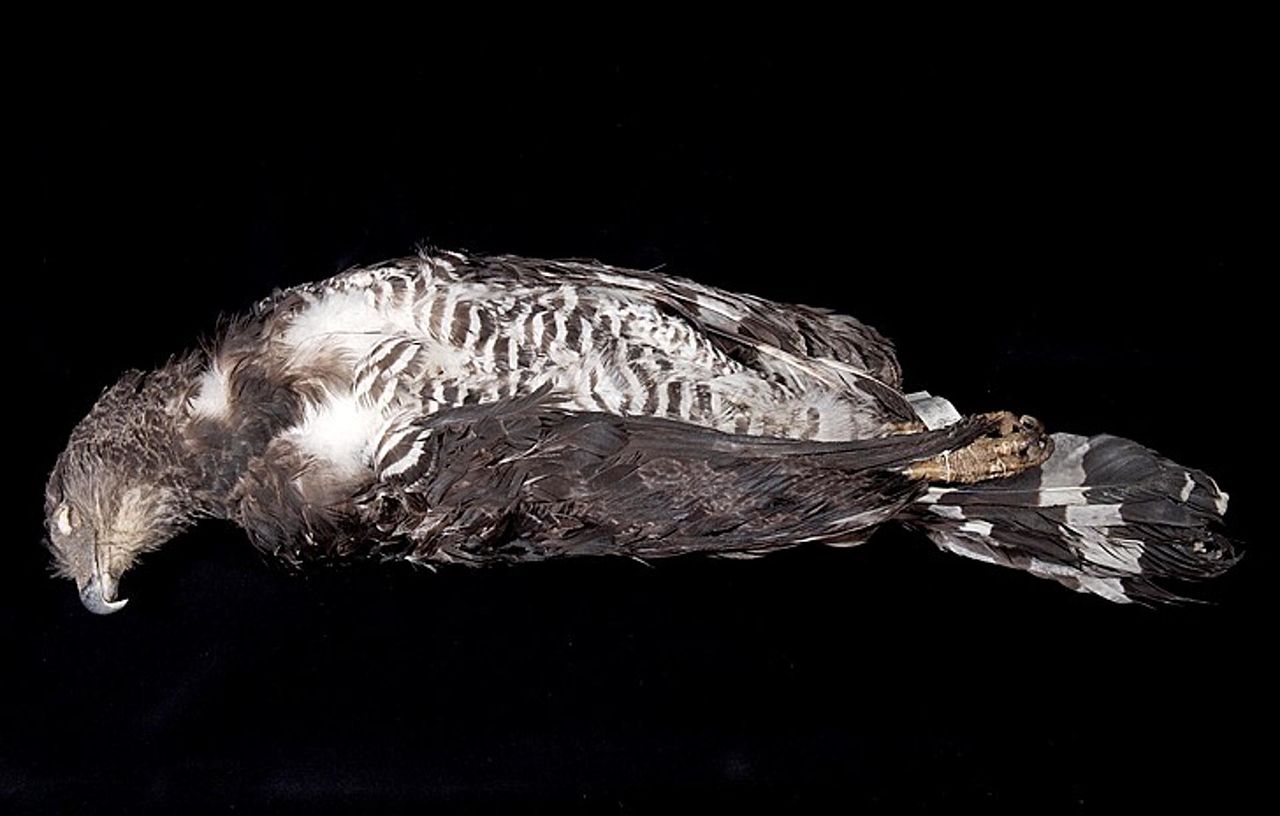
A museum specimen showing a darker hue.
Temperament
solitary and territorial
Flight Pattern
soaring glider with deep, powerful wingbeats; often cruises above or along the forest canopy
Social Behavior
Primarily solitary outside of the breeding season, maintaining large territories. Pairs are monogamous and nest high in emergent trees, typically laying a single egg. The nesting cycle is prolonged, with extended parental care and long intervals between breeding attempts.
Migratory Pattern
Resident
Song Description
Vocalizations are clear, high-pitched whistles and ringing calls that carry over the canopy. Most calling occurs at dawn and early morning, especially near nest sites. Calls can include repeated, plaintive notes given in series.
Plumage
Upperparts brownish-gray to sooty with a contrasting white throat and darker malar line; underparts variably gray with fine barring. Tail prominently banded. Exhibits a small, erect crest with darker tips. Juveniles are paler with a striking dark mask.
Diet
A powerful ambush predator that takes small to medium mammals such as opossums and squirrels, large lizards and snakes, and occasionally other birds. Hunts from concealed perches, launching swift attacks through the subcanopy. Will also patrol along river corridors where prey is concentrated. Diet varies locally with prey availability.
Preferred Environment
Feeds within mature, closed-canopy rainforest, often near waterways, swamps, and forest edges. Avoids open habitats and heavily fragmented forest.


