

The common reed bunting is a passerine bird in the bunting family Emberizidae, a group now separated by most modern authors from the finches, Fringillidae. The genus name Emberiza is from Old German Embritz, a bunting. The specific schoeniclus is from Ancient Greek skhoiniklos, a now unknown waterside bird.
Region
Europe and northern Asia
Typical Environment
Found across much of Europe and into northern and central Asia, breeding chiefly in wetlands with extensive reedbeds, sedges, and cattails. It favors marshes, lake and river margins, wet ditches, and damp meadows with dense cover. Outside the breeding season it also uses farmland edges, stubble, and hedgerows near water. Many northern and eastern populations migrate south and west for winter, while some western populations are resident. Nest sites are low in dense vegetation or in reed tussocks close to water.
Altitude Range
Sea level to 1500 m
Climate Zone
Temperate
Ease of Keeping
Beginner friendly: 1/5
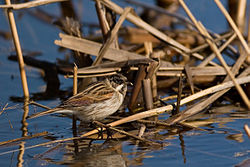
The common reed bunting is a small Palearctic bunting closely tied to wetlands, especially reedbeds and marsh edges. Breeding males show a striking black head and white collar, while females are streakier and more cryptic. It feeds mainly on seeds outside the breeding season but switches to invertebrates to raise young. Habitat loss through wetland drainage and reedbed degradation can impact local populations, though the species remains widespread.




Temperament
shy and skulking in dense cover
Flight Pattern
short rapid wingbeats with an undulating, low flight
Social Behavior
Breeds in pairs with males singing from exposed reed tops or shrubs to defend territories. The nest is placed low in reeds or other dense wetland vegetation. Outside the breeding season it forms small flocks, sometimes mixing with other buntings and finches while feeding in farmland near wetlands.
Migratory Pattern
Partial migrant
Song Description
The song is a simple, repetitive, jangling series of short notes delivered from a perch, often on reed stems. Calls include a sharp 'tsip' and a metallic, ticking note, especially in flight.
Plumage
Streaked brown upperparts with darker mantle and pale edges, buffy underparts with fine flank streaking, and white outer tail feathers. Breeding males have a black head and throat, crisp white collar and moustachial stripe; females and nonbreeding birds are browner with a pale supercilium and lack the full black hood.
Diet
In winter it eats mainly seeds of grasses, sedges, and reeds, often husking them with its stout bill. During the breeding season it switches to invertebrates such as beetles, flies, caterpillars, and spiders, which are crucial for chick growth. It also takes small buds and other plant material when available.
Preferred Environment
Feeds in reedbeds, marsh edges, and wet meadows, picking seeds from stems and foraging on the ground or low vegetation. In winter it often uses field margins, stubble, and hedgerows near damp areas.


