

The common ringed plover or ringed plover is a species of bird in the family Charadriidae. It breeds across much of northern Eurasia, as well as Greenland.
Region
Northern Eurasia and North Atlantic coasts
Typical Environment
Breeds across arctic to temperate zones of northern Europe and Asia, including Iceland and Greenland, with scattered inland colonies on shingle and river gravel bars. Winters along coasts of western and southern Europe, the Mediterranean, the Middle East, and widely in sub-Saharan Africa. Occurs on sandy and shingle beaches, estuaries, saltmarsh edges, and tidal flats. Inland, it uses sparsely vegetated gravel shores of lakes and rivers and man-made habitats such as reservoirs and airfields.
Altitude Range
Sea level to 2000 m
Climate Zone
Temperate
Ease of Keeping
Beginner friendly: 1/5
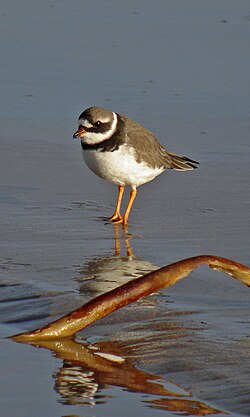
Common ringed plovers perform classic distraction displays, feigning injury to lure predators away from their nests. They feed using a run-and-pause technique on open substrates. Chicks are precocial and leave the nest soon after hatching to feed themselves under parental supervision. Their bright orange legs and bill base are most vivid in the breeding season.


Eggs and newly hatched chicks




Temperament
alert and active, loosely gregarious
Flight Pattern
strong flier with rapid, shallow wingbeats; agile low over shorelines
Social Behavior
Often forages and migrates in small flocks, sometimes mixing with other small shorebirds. Nests on the ground in a simple scrape, typically on open gravel or sand with sparse vegetation. Usually monogamous within a season, both parents incubate and attend young. Performs distraction displays to deter predators near the nest.
Migratory Pattern
Partial migrant
Song Description
Call is a clear, ringing two-note 'too-eet' or 'pee-oo' often given in flight. Display song includes a series of melodious whistles and piping notes, becoming more frequent during courtship and territorial interactions.
Plumage
Compact plover with warm brown upperparts, clean white underparts, and a single bold black breast band. Has a white collar and forehead patch set off by a black mask and cap in breeding plumage. Flight shows a narrow white wing bar and white tail sides. Bill short and straight with orange base and black tip; legs bright orange.
Diet
Eats small invertebrates such as insects, marine worms, crustaceans, and mollusks. Uses a run-and-pause foraging style to spot and pick prey from the surface. On beaches and mudflats it probes shallowly or pecks visually detected prey. Inland birds take insects and larvae from gravel bars and shorelines, and occasionally small seeds.
Preferred Environment
Feeds on open substrates including sandy and shingle beaches, estuarine mudflats, and saltmarsh margins. Inland, frequents lake shores, riverbanks with exposed gravel, and sparsely vegetated flats. Often forages along the tideline and on wet sand where prey is concentrated.


