

The common rock thrush, also known as the rufous-tailed rock thrush or simply rock thrush, is a species of chat that breeds in southern Europe across Central Asia to northern China. This species is strongly migratory, all populations wintering in Africa south of the Sahara. It is an uncommon visitor to northern Europe. Its range has contracted somewhat at the periphery in recent decades due to habitat destruction. For example, in the early 20th century it bred in the Jura Krakowsko-Częstochowska (Poland) where none occur today, but it is not considered globally endangered.
Region
Western Palearctic and sub-Saharan Africa
Typical Environment
Breeds on open, rocky hillsides, alpine and subalpine meadows with scattered shrubs, cliffs, scree slopes, and gorges from southern Europe across Central Asia to northern China. It also uses abandoned buildings, quarries, and ruins where suitable crevices are available. In winter it disperses to rocky savannas, open bushland, and dry hillsides south of the Sahara. Outside breeding, it frequents edges of cultivation and lightly wooded slopes but still favors stony terrain. It avoids dense forests and flat, featureless plains.
Altitude Range
200–3500 m
Climate Zone
Highland
Ease of Keeping
Beginner friendly: 1/5
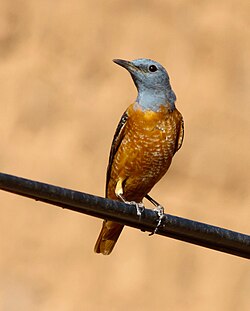
Males are striking with a blue head and chest and rich rufous underparts and tail, while females are brown and finely scaled for camouflage. It nests in rock crevices on open, stony slopes and often sings from prominent perches or during fluttering song flights. A long-distance migrant, it breeds across southern Europe to northern China and winters in sub‑Saharan Africa. Local declines have been linked to habitat changes in mountain pastures and rocky grasslands.



Temperament
solitary and territorial
Flight Pattern
short rapid wingbeats with agile, fluttering song-flights
Social Behavior
Typically breeds as solitary pairs, males defending rocky territories with song from elevated perches. Nests are placed in crevices, cavities, or holes in cliffs, walls, or ruins. Clutches usually contain 4–6 eggs; both adults feed the young. Outside the breeding season, individuals may loosely associate in areas with concentrated food.
Migratory Pattern
Seasonal migrant
Song Description
Rich, melodious, thrush-like phrases with varied whistles and fluty notes. Often delivered from a prominent rock or during a buoyant song-flight, carrying well across open slopes.
Plumage
Male with blue head and breast, bright rufous underparts and tail, and a distinct white wing panel visible in flight; female brown with fine scaling and mottling on underparts and a rufous tail.
Diet
Primarily hunts insects such as beetles, grasshoppers, caterpillars, and ants, as well as spiders and other small invertebrates. Occasionally takes small vertebrates like tiny lizards. In late summer and on migration, it supplements its diet with berries and other soft fruits. Prey is usually taken by ground foraging, short sallies from perches, or gleaning among rocks.
Preferred Environment
Feeds on open rocky ground, stony pastures, scree, and cliff ledges with scattered shrubs or boulders. In winter it forages in rocky savannas and bushy hillsides, often near outcrops or ruins.


