

The common crane, also known as the Eurasian crane, is a bird of the family Gruidae, the cranes. A medium-sized species, it is the only crane commonly found in Europe besides the demoiselle crane and the Siberian crane that only are regular in the far eastern part of the continent. Along with the sandhill crane, demoiselle crane and the brolga, it is one of only four crane species not currently classified as threatened with extinction or conservation dependent on the species level. Despite the species' large numbers, local extinctions and extirpations have taken place in part of its range, and an ongoing reintroduction project is underway in the United Kingdom.
Region
Eurasia
Typical Environment
Breeds in boreal and temperate zones from Scandinavia and the Baltic through European Russia to Siberia and Mongolia. Prefers wetlands such as bogs, marshes, fen-woodlands, and wet meadows for nesting, often with surrounding forest or shrub cover. In winter it frequents open agricultural lands, steppe, and river floodplains near safe communal roosts in shallow water. Major wintering areas include the Iberian Peninsula, North Africa, the Middle East, northern India, and eastern China. Large traditional stopovers occur in places like southern Sweden, Germany, and Hungary.
Altitude Range
0–2600 m
Climate Zone
Temperate
Ease of Keeping
Beginner friendly: 1/5
Also called the Eurasian crane, it breeds across northern Europe and Asia and winters farther south into the Mediterranean, North Africa, the Middle East, and South Asia. It is famous for its elaborate courtship dances and loud, resonant bugling calls that carry over long distances. Large staging flocks gather at traditional stopover sites during migration, sometimes numbering in the tens of thousands.


Common cranes in Osmussaar, Estonia. Wetlands are preferred habitats for the cranes.

The long coiled trachea (TR) penetrating the sternum (S, K, A) produces the trumpeting calls of the crane. L on the left - lungs, LA - larynx, L on the right - tongue.


"Departure of Cranes" - picture of 1870 by Józef Chełmoński (National Museum in Cracow)
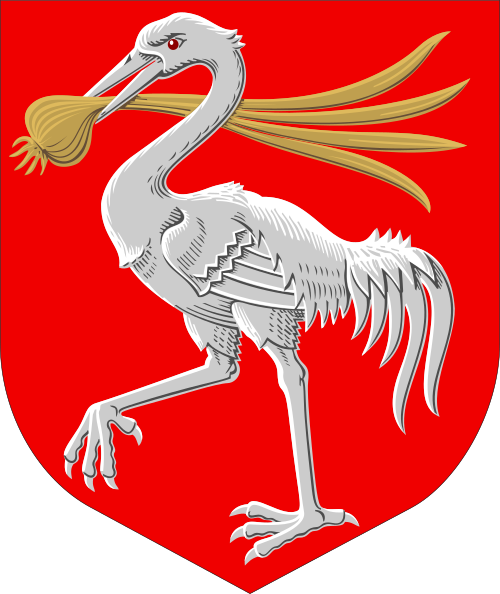
A common crane in the coat of arms in the Tervola municipality
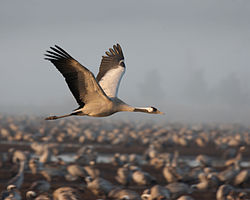


Temperament
social and wary
Flight Pattern
strong flier and soaring glider
Social Behavior
Monogamous pairs breed solitarily or in loose colonies, nesting on the ground in wetlands. Outside the breeding season they are highly gregarious, forming large flocks at feeding sites and communal roosts. Courtship includes synchronized dancing, bowing, and leaping displays accompanied by duetting calls.
Migratory Pattern
Seasonal migrant
Song Description
Powerful, trumpeting bugles that are resonant and far-carrying, often delivered in synchronized duets by pairs. Calls intensify during display and at dawn and dusk around roosts.
Plumage
Overall smooth grey plumage with black flight feathers and drooping tertials forming a bustle. Head and upper neck show a striking white facial stripe contrasting with black throat and nape. A bare red crown patch is prominent in adults.
Diet
An opportunistic omnivore, it eats grains and seeds, roots and tubers, and a wide range of animal prey including insects, earthworms, snails, small vertebrates, and amphibians. During migration and winter it often relies heavily on spilled cereals, maize, and sunflower seeds in agricultural fields. In the breeding season, it forages more in wetlands for invertebrates and small vertebrates.
Preferred Environment
Feeds in shallow wetlands, wet meadows, and extensively in open farmland and stubble fields near secure roosting sites. Uses quiet shorelines and mudflats for probing and gleaning.


