The brown-throated parakeet, also known as the St. Thomas conure or brown-throated conure in aviculture, is a species of bird in the subfamily Arinae of the family Psittacidae, the African and New World parrots. It is found in Costa Rica, Panama, the northern mainland of South America, and islands off the South American coast.
Region
Northern South America and southern Central America
Typical Environment
Occurs from Costa Rica and Panama through northern Colombia and Venezuela into the Guianas, with populations on several offshore islands such as Aruba, Curaçao, Bonaire, and Margarita. It favors open and semi-open habitats including dry thorn scrub, savanna, and open woodland, as well as gallery forest edges and mangroves. On arid islands it is common in cactus-dominated scrub. The species readily uses farmland, plantations, and suburban parks. It tolerates human-altered landscapes and can be conspicuous near settlements.
Altitude Range
Sea level to 1500 m
Climate Zone
Tropical
Ease of Keeping
Beginner friendly: 3/5
This adaptable parakeet, also called the St. Thomas conure, thrives in both natural dry forests and urban areas. It frequently nests in tree cavities and arboreal termite mounds, and forms noisy flocks around feeding and roost sites. There are many recognized subspecies that vary in head and throat coloration. In some places it raids crops, bringing it into conflict with farmers.


Temperament
social and noisy
Flight Pattern
strong flier with rapid, direct wingbeats
Social Behavior
Typically seen in pairs or small to medium flocks that may gather into larger groups at favored feeding and roost sites. Nests in tree cavities and often in arboreal termite mounds; pairs maintain close contact and defend the immediate nest area. Roosting is communal outside the breeding season.
Migratory Pattern
Resident
Song Description
Vocalizations are loud, harsh screeches and chattering calls that carry over long distances in flight. At close range, pairs exchange softer trills and chatter, especially near the nest.
Plumage
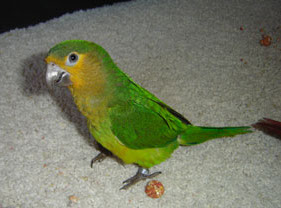
Mostly green with a contrasting brownish throat and face, variable yellow to orange on the cheeks and forehead depending on subspecies, and blue tones in the flight feathers.
Diet
Feeds mainly on seeds, fruits, berries, and flower parts, occasionally taking nectar. It forages in trees and shrubs, often targeting seasonally abundant resources. In agricultural areas it may feed on cultivated grains and fruits, sometimes becoming a local crop pest.
Preferred Environment
Most feeding occurs in the canopy and edges of dry forest, scrub, and savanna, as well as in plantations and urban parks. Flocks move between scattered food trees and water sources, using hedgerows and field margins.