

The brown-throated wattle-eye, also known as the common wattle-eye or scarlet-spectacled wattle-eye, is a small, insectivorous passerine bird. The wattle-eyes were previously classed as a subfamily of the Old World flycatcher family Muscicapidae, but are now usually separated from that group.
Region
West and Central Africa
Typical Environment
Occurs widely from West Africa east into parts of Central and some East African countries, inhabiting forest edges, riverine thickets, wooded savanna, and secondary forest. It favors the understorey and mid-storey where it can glean and sally for prey. It is commonly found in degraded forest mosaics and gardens near woodland. Dense tangles and vine-laden edges are particularly attractive, and it often forages along shaded trails. Proximity to watercourses with riparian vegetation is also typical.
Altitude Range
Sea level to 1800 m
Climate Zone
Tropical
Ease of Keeping
Beginner friendly: 2/5
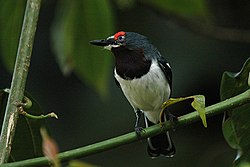
This small wattle-eye is notable for the male’s vivid scarlet orbital wattles that form ‘spectacles’ around the eyes and a rich brown throat patch. Pairs often perform coordinated duets and display tail-flicking while foraging. Formerly grouped with Old World flycatchers, wattle-eyes are now placed in the family Platysteiridae. It adapts well to secondary growth and forest edges, which helps keep its populations stable.


Temperament
active and territorial
Flight Pattern
short rapid wingbeats with frequent short sallies
Social Behavior
Usually found in pairs that maintain small territories year-round. Pairs engage in duetting and coordinated displays while foraging. The nest is a small cup placed low to mid-level in dense vegetation, and both adults participate in care.
Migratory Pattern
Resident
Song Description
Song is a series of clear, whistled notes often delivered as antiphonal duets between pair members. Calls include sharp ticks and high-pitched ‘tsee’ notes given during foraging and alarm.
Plumage
Compact, short-tailed bird with contrasting patterning; male shows glossy black upperparts, white underparts, and a rich brown throat; female is browner above with a rufous-brown throat and paler underparts. Both sexes often show a distinct white wing patch.
Diet
Primarily small insects such as flies, beetles, caterpillars, and ants, along with spiders and other arthropods. It gleans prey from leaves and twigs and makes short sallies to snatch flying insects. Occasionally hawks from low perches along forest edges.
Preferred Environment
Feeds in the understorey and mid-storey of forest edges, riparian thickets, and secondary woodland. Often works through vine tangles, saplings, and shaded paths, sometimes near human-modified habitats with dense shrub cover.


