
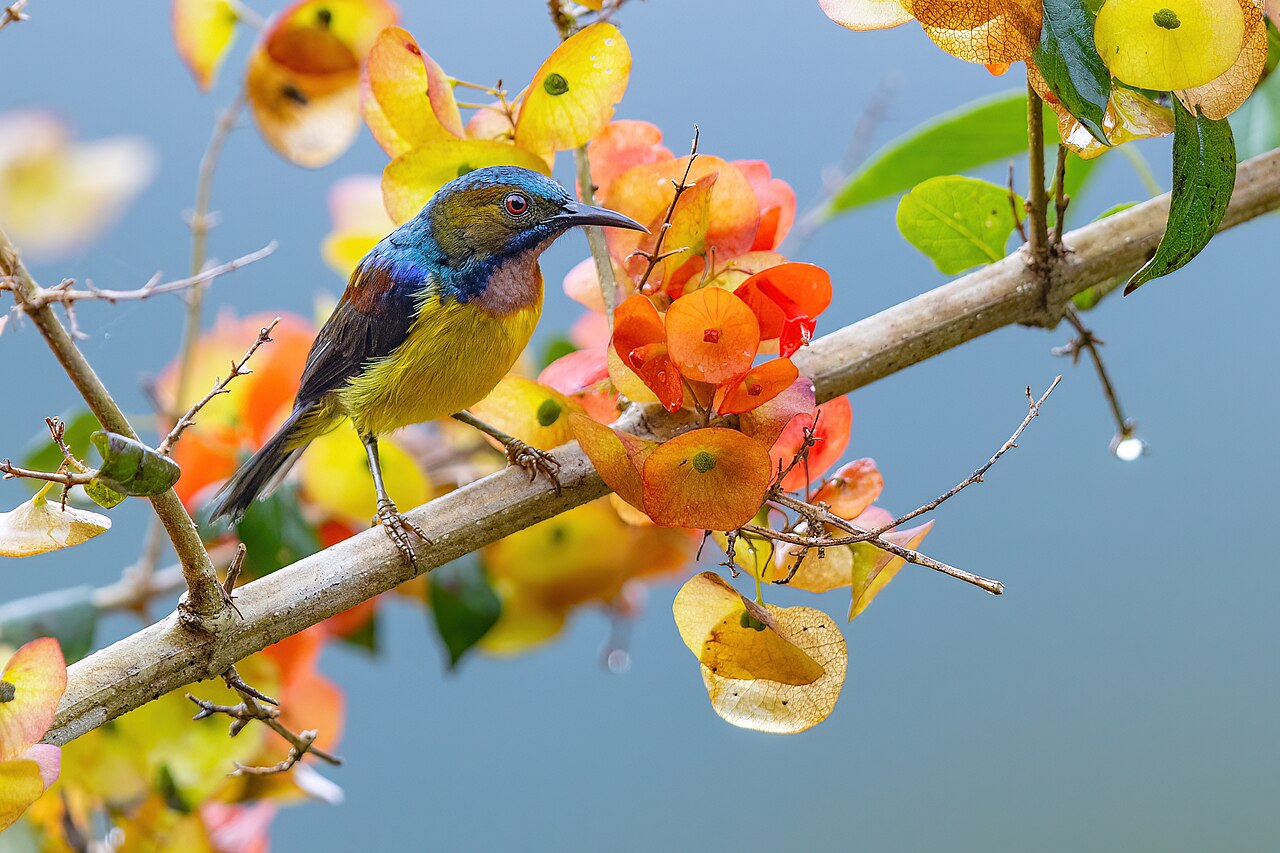
The brown-throated sunbird, also known as the plain-throated sunbird, is a species of bird in the family Nectariniidae. It is found in a wide range of semi-open habitats in south-east Asia, ranging from Myanmar to the Lesser Sundas and west Philippines. The grey-throated sunbird found in the remaining part of the Philippines is often considered a subspecies of the brown-throated sunbird, but the two differ consistently in measurements and plumage, and there is no evidence of intergradation between them.
Region
Southeast Asia
Typical Environment
Occurs widely from southern Myanmar and Thailand through Peninsular Malaysia and Singapore, across Sumatra, Borneo, Java, and the Lesser Sundas, and into the western Philippines. It favors semi-open lowland habitats including forest edge, secondary growth, mangroves, plantations, parks, and suburban gardens. The species often concentrates where flowering trees and shrubs are abundant, including coastal areas. It tolerates human presence well and can be common in urban greenery.
Altitude Range
Sea level to 1500 m
Climate Zone
Tropical
Ease of Keeping
Beginner friendly: 1/5
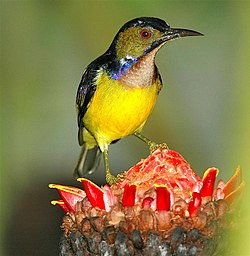
A common sunbird of Southeast Asia, it thrives in gardens, forest edges, and mangroves, often visiting ornamental flowers. Males show striking iridescent head and rump contrasts with a warm brown throat, while females are more subdued olive-yellow. Its brush-tipped tongue lets it efficiently extract nectar and it also helps pollinate many native plants. The species builds a distinctive hanging, purse-like nest from plant fibers and spider silk.




Temperament
active and territorial
Flight Pattern
short rapid wingbeats
Social Behavior
Usually seen singly, in pairs, or small family groups, defending rich flower patches from rivals. Nest is a hanging, pouch-like structure suspended from a twig or frond, built from fibers, leaves, and spider silk. Likely socially monogamous during breeding, with both parents feeding the young.
Migratory Pattern
Resident
Song Description
High-pitched, rapid twittering notes interspersed with sharp metallic chips. Calls are buzzy and repetitive, often given while actively foraging among flowers.
Plumage
Male with iridescent green to bluish-green head and nape, chestnut-brown throat and upper breast, olive upperparts, and bright yellow underparts with a bluish-violet rump. Female mostly olive-green above with yellow underparts and a plainer, paler throat; lacks the male’s iridescence. Both sexes have a slender, downcurved bill suited to nectar feeding.
Diet
Primarily feeds on nectar from flowering trees, shrubs, and garden ornamentals such as hibiscus and bottlebrush. Uses a brush-tipped tongue to lap nectar efficiently and will probe repeatedly along inflorescences. Supplements diet with small arthropods—spiders, caterpillars, and tiny beetles—especially when feeding nestlings. Occasionally takes small fruits or juice from soft berries.
Preferred Environment
Forages in canopy and mid-story of forest edge, mangroves, and urban gardens, as well as hedgerows and plantations. Often visits flowering coastal scrub and landscaped parks, moving methodically between blossoms.


