

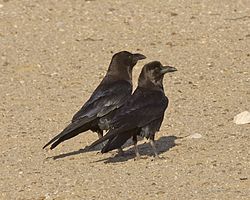
The brown-necked raven is a larger bird than the carrion crow though not as large as the common raven. It has similar proportions to the common raven but the bill is not so large or deep and the wings tend to be a little more pointed in profile. The head and throat are a distinct brownish-black giving the bird its English name, while the rest of the plumage is black glossed with purple, blue or purplish-blue. Like the common raven, thick-billed raven and white-necked raven, it is one of the larger raven species. The feathers of this species often fade quite quickly to a brownish black and the bird can look distinctly brown by the time it moults. The feet, legs and bill are black. The dwarf raven was formerly considered a subspecies but this bird now appears to be closer to the pied crow than this species.
Region
North Africa and the Arabian Peninsula
Typical Environment
This species inhabits deserts and semi-deserts across the Sahara and Sahel margins, the Nile Valley deserts, the Red Sea coast, the Arabian Peninsula, and parts of the Middle East. It favors rocky wadis, escarpments, open gravel plains, and dunes, as well as oases and human-altered sites like garbage dumps. Nests are placed on cliffs, isolated trees, power pylons, or buildings. It often occurs near pastoral camps and along roads where carrion and refuse are available.
Altitude Range
Sea level to 2500 m
Climate Zone
Arid
Ease of Keeping
Beginner friendly: 2/5
A desert-adapted corvid, the brown-necked raven often scavenges along roads, near settlements, and at oases, showing remarkable boldness and problem-solving ability. Its head and throat have a brownish cast that can become more evident as the plumage fades in the sun. Pairs are typically lifelong and defend territories around nest sites on cliffs, trees, or pylons. The so‑called dwarf raven once treated as a subspecies is now regarded as closer to the pied crow.



Temperament
wary yet bold and highly inquisitive
Flight Pattern
strong flier with deep wingbeats and frequent soaring; wings slightly more pointed than the common raven
Social Behavior
Usually found in pairs or small family groups; outside the breeding season it may form loose flocks at rich food sources or communal roosts. Pairs are monogamous and defend nesting territories. Nests are bulky stick platforms lined with softer materials.
Migratory Pattern
Resident
Song Description
Vocalizations include deep, guttural croaks and grating calls reminiscent of the common raven but often higher and drier in tone. It also produces rattles, clucks, and a variety of harsh notes, with softer contact calls when foraging.
Plumage
Glossy black overall with a distinct brownish-black head and throat; sun-exposed feathers often fade to a browner tone. Plumage shows a purplish to blue sheen in good light, with shaggy throat hackles.
Diet
An opportunistic omnivore, it takes carrion, large insects, reptiles, small mammals, and the eggs or nestlings of other birds. It also eats seeds, dates, grains, and human food scraps, frequently scavenging around settlements and dumps. Food caching is common when surplus is available.
Preferred Environment
Forages in open desert, rocky wadis, coastal flats, oases, and around human habitation such as towns, camps, abattoirs, and road verges. It often follows roads and pastoral herds where carrion and refuse are predictable.


