
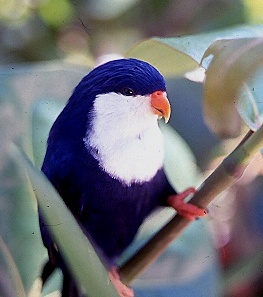
The blue lorikeet is a small lorikeet from French Polynesia and the Cook Islands. It is also known as the Tahiti lorikeet, violet lorikeet, Tahitian lory, blue lory, nunbird, and the indigo lory. It was formerly found on 23 islands around Tahiti, but is now restricted to perhaps eight islands: Aitutaki, Apataki, Arutua, Kaukura, Manuae, Maupihaa, Motu One, Rangiroa, and possibly Manihi and Manuae. Its plumage is mainly dark blue and it has a white area over its upper chest, throat and face. The first captive breeding in the UK was by the Marquess of Tavistock in the 1930s. He was awarded a silver medal by the Foreign Bird League for this achievement.
Region
South Pacific (French Polynesia and Cook Islands)
Typical Environment
Today it persists on a handful of low coral atolls and small islands, including Aitutaki (Cook Islands) and several Tuamotu atolls such as Rangiroa, Apataki, Arutua, and Kaukura. It favors coastal woodland, coconut plantations, village gardens, and shrubby islets with abundant flowering trees and shrubs. Nesting typically occurs in cavities in coconut palms or other trees. The species is noticeably more common on islands free of invasive rats and cats. Historical range around Tahiti contracted markedly during the 20th century.
Altitude Range
Sea level to 300 m
Climate Zone
Tropical
Ease of Keeping
Beginner friendly: 2/5
Also called the Tahiti or violet lorikeet, this small parrot is largely deep blue with a striking white face and throat. It uses a brush-tipped tongue to lap nectar and pollen from flowers, especially on atolls with coconut palms and coastal shrubs. Populations have declined on many islands due to invasive rats and habitat changes, and surviving strongholds are often on predator-free islets. A Cook Islands population (Aitutaki) is established and stable, likely from historical introduction.


Vini peruviana in Rangiroa

At Walsrode Bird Park, Germany
Temperament
social and active
Flight Pattern
short rapid wingbeats
Social Behavior
Usually seen in pairs or small family groups, often commuting between flowering trees. Strong pair bonds are typical, and nests are placed in cavities of coconut palms or other trees. Clutches are small, and adults defend feeding sites vigorously from other nectar-feeders.
Migratory Pattern
Resident
Song Description
High, thin chatter and squeaky contact calls delivered rapidly while feeding or in flight. At roosts it can become noisy, with repeated scolding notes and sharp screeches typical of lorikeets.
Plumage
Compact lorikeet with glossy, dark cobalt to violet-blue plumage and a clean white patch across the throat, upper chest, and face.
Diet
Primarily nectar and pollen taken with a brush-tipped tongue from coconut, hibiscus, erythrina, and other flowering trees and shrubs. Also consumes soft fruits and blossoms and may take small quantities of seeds. Occasional ingestion of small invertebrates is possible while foraging among flowers.
Preferred Environment
Feeds in coastal groves, coconut plantations, and village gardens rich in flowering plants. Often forages high in the canopy but will descend to shrubs and ornamental plantings.


