

The black-throated huet-huet Spanish pronunciation: [wet wet] is a species of bird in the family Rhinocryptidae. It is found in southern/central Chile and adjacent western Argentina. Its natural habitat is temperate forest.
Region
Southern Andes
Typical Environment
Occurs in the Valdivian temperate rainforests and adjacent Andean foothills of south-central Chile and neighboring western Argentina. It favors mature and secondary Nothofagus (southern beech) forests with a dense Chusquea bamboo understory. Often found along ravines, stream edges, and forested slopes where leaf litter and fallen logs are abundant. It avoids open habitats and generally remains concealed within thick cover. Local presence depends on intact understory structure.
Altitude Range
Sea level to 1800 m
Climate Zone
Temperate
Ease of Keeping
Beginner friendly: 1/5
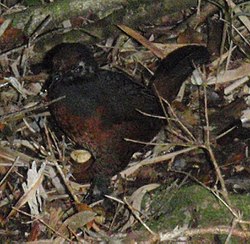
The black-throated huet-huet is a large, ground-dwelling tapaculo of the temperate forests of southern Chile and adjacent western Argentina. Its name comes from its loud, resonant duet of 'huet-huet' notes, often delivered by mated pairs from dense understory cover. It runs and hops powerfully through bamboo thickets and rarely flies, preferring to stay near the forest floor. It nests in burrows excavated into earth banks or under roots.


Temperament
solitary and territorial
Flight Pattern
short rapid wingbeats, prefers to run and hop
Social Behavior
Typically encountered as solitary individuals or territorial pairs. Pairs maintain year-round territories and often duet to advertise and defend them. Nests are placed in tunnels excavated into banks or under roots, where both sexes participate in digging and rearing the young.
Migratory Pattern
Resident
Song Description
A loud, resonant series of paired 'huet-huet' notes, often given antiphonally by mates. Calls carry far through dense forest and are most frequent at dawn and dusk. The song is distinctive and often the best way to detect the species.
Plumage
Robust, round-bodied bird with rich brown upperparts and rufous-brown underparts; throat and upper breast are dark to blackish with pale speckling. Flanks often show warmer rufous tones, and the tail is short and usually held cocked. Plumage is soft and dense, aiding its skulking lifestyle in damp forests.
Diet
Primarily takes ground-dwelling invertebrates such as beetles, larvae, spiders, and earthworms. It also probes rotting logs and leaf litter for hidden prey. Small amounts of seeds or berries may be taken opportunistically, especially in cooler months. Foraging relies on strong legs to scratch and a stout bill to pry and probe.
Preferred Environment
Feeds on the forest floor within dense bamboo and shrub understory. Often works along stream margins, fallen logs, and root tangles where prey accumulates. Frequently forages under cover, rarely venturing into open areas.


