

The black-throated munia or Jerdon's mannikin is a small passerine bird. This estrildid finch is a resident breeding bird in the hills of southwest India, the Western Ghats, Eastern Ghats and Sri Lanka.
Region
South India and Sri Lanka
Typical Environment
Found in the hills of southwestern India across the Western Ghats, parts of the Eastern Ghats, and widely in Sri Lanka. It uses open grasslands, edges of moist forest, riverine scrub, and agricultural landscapes, especially rice paddies and fallow fields. Birds frequently forage along roadsides and weedy clearings where seeding grasses are abundant. Outside the breeding season, they gather in small to medium flocks and may move locally in search of food.
Altitude Range
0–2000 m
Climate Zone
Tropical
Ease of Keeping
Beginner friendly: 2/5
Also known as Jerdon's mannikin, this estrildid finch is a close relative of the scaly-breasted munia but shows a distinctive black throat and upper breast. It often forms tight flocks that forage on grass seed heads and visit paddy fields. Nests are dome-shaped balls of grass hidden in shrubs or reeds, and both parents share incubation and chick-rearing.

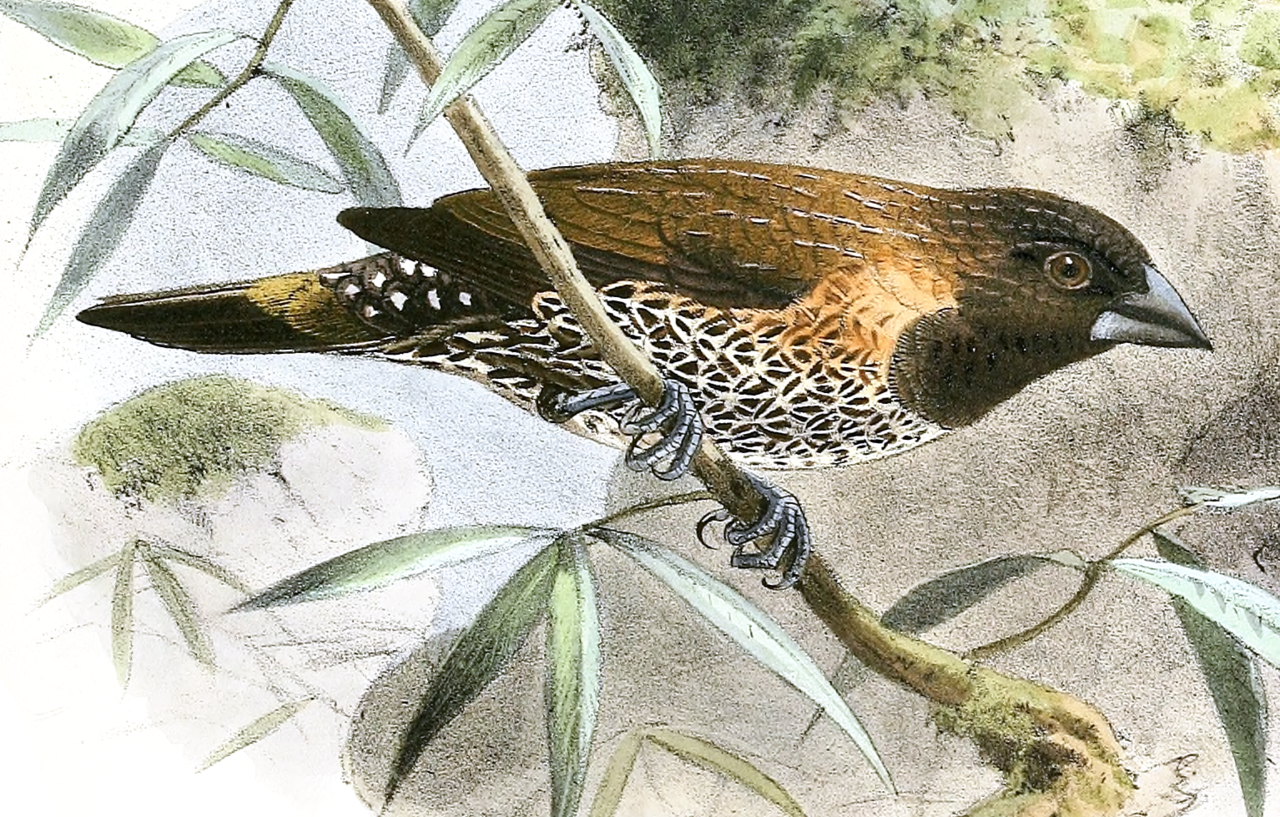
L. k. kelaarti by J. G. Keulemans (1880)
Temperament
social and active
Flight Pattern
short rapid wingbeats
Social Behavior
Typically seen in small flocks that keep close contact while feeding and commuting between grass patches and fields. Pairs form within flocks; they build domed grass nests low in shrubs, reeds, or tall grasses. Both sexes participate in nest construction, incubation, and feeding of nestlings.
Migratory Pattern
Resident
Song Description
Soft, high-pitched twittering and tinkling notes delivered in short phrases. Contact calls are thin chips used to maintain flock cohesion, with a gentle warble during courtship.
Plumage
Warm brown upperparts with a contrasting black throat and upper breast, shading into paler, finely scaled underparts. The belly and flanks show subtle scaly patterning, and the rump is brown. Feathers are smooth and neatly compact, typical of munias.
Diet
Primarily consumes small grass and sedge seeds, including cultivated rice when available. It also takes green seed husks and occasionally small invertebrates, especially for protein during the breeding season. Foraging involves husking seeds on the perch and gleaning directly from seed heads.
Preferred Environment
Feeds in open grassy areas, rice paddies, weedy field margins, and along edges of scrubby wetlands. It often clings to seeding grasses or forages on the ground under dense cover.


