The black-throated bushtit, also known as the black-throated tit, is a very small passerine bird in the family Aegithalidae.
Region
South and East Asia
Typical Environment
Found from the Himalayan foothills of northern India, Nepal and Bhutan across Myanmar and much of southern and central China, reaching parts of Southeast Asia and Taiwan. It frequents broadleaf and mixed montane forests, bamboo thickets, forest edges and secondary growth, and readily enters parks and wooded gardens. The species is largely sedentary but may shift locally with season and food availability. It favors dense shrub layers and canopy gleaning sites where small insects and berries are abundant.
Altitude Range
200–3500 m
Climate Zone
Subtropical
Ease of Keeping
Beginner friendly: 2/5
Also called the black-throated tit, this tiny passerine travels in busy flocks and often joins mixed-species foraging parties. It builds a neat, domed, moss-and-spider-silk nest with a side entrance, well camouflaged in dense foliage. Subspecies vary noticeably in head pattern and rufous tones across its wide Asian range.


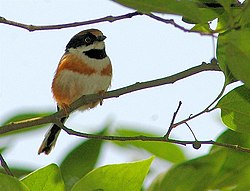

Black-throated bushtit Scientific name: Aegithalos concinnus Theog Forest Division Shimla H.P.
Temperament
social and active
Flight Pattern
short rapid wingbeats
Social Behavior
Typically moves in small, chattering flocks and often joins mixed-species parties in forests and edges. Pairs may be loosely territorial during breeding, constructing well-hidden domed nests from moss, lichens, and spider silk. Family groups often remain together after fledging.
Migratory Pattern
Resident
Song Description
High, thin tit-like calls delivered in rapid, tinkling series, often while foraging. The song is a fast, twittering sequence interspersed with sharp tsit notes, carrying well through undergrowth.
Plumage
Compact, long-tailed tit with a neat, domed head pattern; plumage shows warm rufous tones on crown and flanks, grey-brown upperparts, and a crisp black throat patch. Wings are dusky with pale fringes and the tail is long with white edges. Subspecies differ in extent of rufous on crown and mask.
Diet
Primarily small insects, caterpillars, aphids, and spiders gleaned from leaves and twigs. Also takes small berries and soft fruits and occasionally nectar, especially outside the breeding season. Foraging is energetic, with frequent hanging and short hover-gleans at foliage tips.
Preferred Environment
Feeds in dense shrub layers, forest edges, bamboo stands, and the mid- to upper canopy of mixed and broadleaf forests. Common in secondary growth and village groves, and will use well-vegetated gardens.