
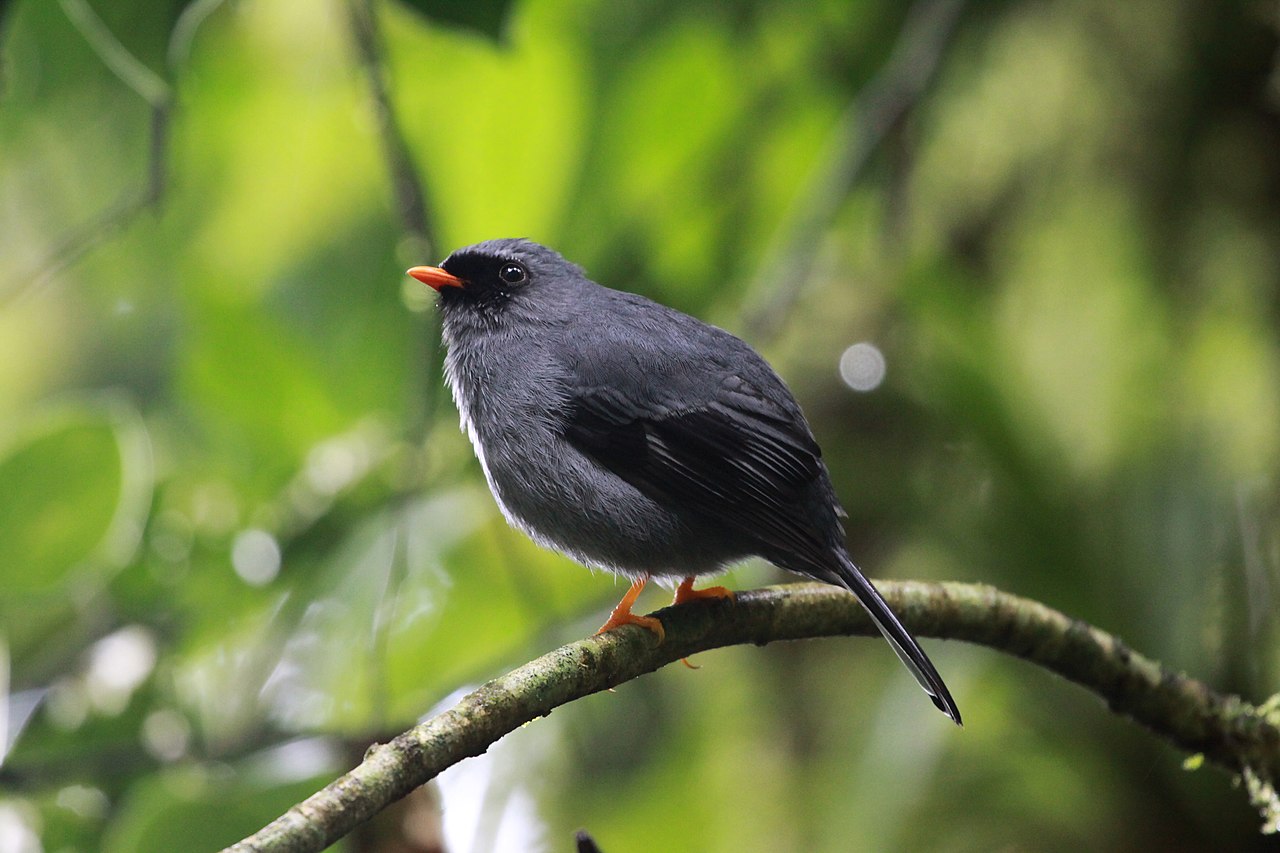
The black-faced solitaire is a bird in the thrush family endemic to highlands in Costa Rica and western Panama.
Region
Central American highlands
Typical Environment
Occurs in humid montane and cloud forests of Costa Rica and western Panama, favoring dense, mossy ravines and steep forested slopes. It uses mature forest as well as well-regenerated secondary growth with ample fruiting trees and shrubs. Birds often remain within shaded understory and midstory, moving quietly through tangles and along stream gullies. It may visit forest edges and clearings when fruit is abundant, but generally avoids open habitats.
Altitude Range
900–3000 m
Climate Zone
Highland
Ease of Keeping
Beginner friendly: 1/5
Renowned for one of the most beautiful, flute-like songs in the Neotropics, the black-faced solitaire is often heard long before it is seen. It keeps to the dim understory of cloud forests and can be quite shy. Illegal trapping for the cage-bird trade has affected some populations, though it remains locally common in protected highland forests. As a major fruit-eater, it helps disperse seeds of many montane trees.


Temperament
shy and skulking
Flight Pattern
short rapid wingbeats through understory; agile but usually low, direct flights
Social Behavior
Typically solitary or in pairs, especially during the breeding season. Nests are cup-shaped, placed on banks, ledges, or dense vegetation in shaded ravines. Adults are attentive parents, quietly ferrying fruit and insects to the nest. Outside breeding, individuals may loosely associate at fruiting trees.
Migratory Pattern
Resident
Song Description
A rich, ethereal series of clear, flute-like notes that carry far through cloud forest. Phrases are melodious, varied, and often delivered from concealed perches. Calls include thin, high whistles and soft squeaks.
Plumage
Smooth, slaty-gray body with a bold black face and throat mask; subtly warmer, cinnamon-tinged undertail coverts. Feathers appear sleek and uniform with minimal streaking.
Diet
Primarily consumes small fruits and berries, swallowing them whole and later regurgitating seeds, thus aiding forest regeneration. Also takes insects and other small invertebrates, especially when feeding young. Forages methodically, pausing to glean or pluck fruit from foliage and vine tangles.
Preferred Environment
Feeds in the understory and midstory of humid montane forest, along shaded trails, streams, and ravines. Frequently visits fruiting trees and shrubs at forest edges or light gaps. Rarely ventures into open areas away from cover.


