

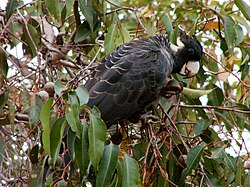
Baudin's black cockatoo, also known as Baudin's cockatoo or the long-billed black cockatoo, is a species of genus Zanda found in southwest Australia. The epithet commemorates the French explorer Nicolas Baudin. It has a short crest on the top of its head, and the plumage is mostly greyish black. It has prominent white cheek patches and a white tail band. The body feathers are edged with white giving a scalloped appearance. Adult males have a dark grey beak and pink eye-rings. Adult females have a bone coloured beak, grey eye-rings and ear patches that are paler than those of the males.
Region
Southwest Australia
Typical Environment
Occurs in the jarrah–marri and karri forests of the Swan Coastal Plain and Darling Range, extending through the wetter forests of southwest Western Australia. It favors mature eucalypt forests with abundant marri, jarrah, and karri, and also uses adjacent farmlands and orchards for feeding. Large roosts form near watercourses and in tall trees. Nesting requires very large, old hollows in living or dead eucalypts. Outside breeding, birds range widely following seed and flowering cycles.
Altitude Range
Sea level to 600 m
Climate Zone
Temperate
Ease of Keeping
Beginner friendly: 1/5
Also called the long-billed black cockatoo, it is adapted to extract seeds from marri (Corymbia calophylla) ‘honky nuts’ using its unusually long, slender bill. It is often confused with Carnaby’s black cockatoo but has a noticeably longer bill and finer bill tips. The species has declined due to loss of old hollow-bearing eucalypts and conflict in orchards where it feeds on pome fruits. It is legally protected in Australia.




Portrait of a female



Temperament
social and noisy
Flight Pattern
strong flier with slow, deep wingbeats; occasional soaring glides
Social Behavior
Monogamous pairs nest in large tree hollows, with the female incubating while the male provides food. Outside the breeding season, birds form roaming flocks that gather at traditional communal roosts. They are attentive parents and may use the same nesting hollows for many years.
Migratory Pattern
Partial migrant
Song Description
Calls include drawn-out wailing notes and ringing ‘wee-laa’ cries typical of black cockatoos. Contact calls are loud and carry over long distances, while softer grating notes are used at close range within flocks.
Plumage
Mostly greyish-black with narrow whitish edges to body feathers creating a scalloped effect; prominent white cheek patches and a broad white tail band.
Diet
Primarily consumes seeds of marri, jarrah, and karri, using its long bill to extract kernels from woody capsules. It also takes seeds from banksia and hakea and will feed on orchard fruits such as apples and pears, often targeting the seeds. Birds sometimes glean seeds from fallen ‘honky nuts’ on the ground and may supplement with buds and flowers seasonally.
Preferred Environment
Feeds mostly in the canopy of mature eucalypt forests and along forest edges. It regularly visits agricultural landscapes and orchards adjacent to native forest, and assembles at known feeding trees near communal roosts.


