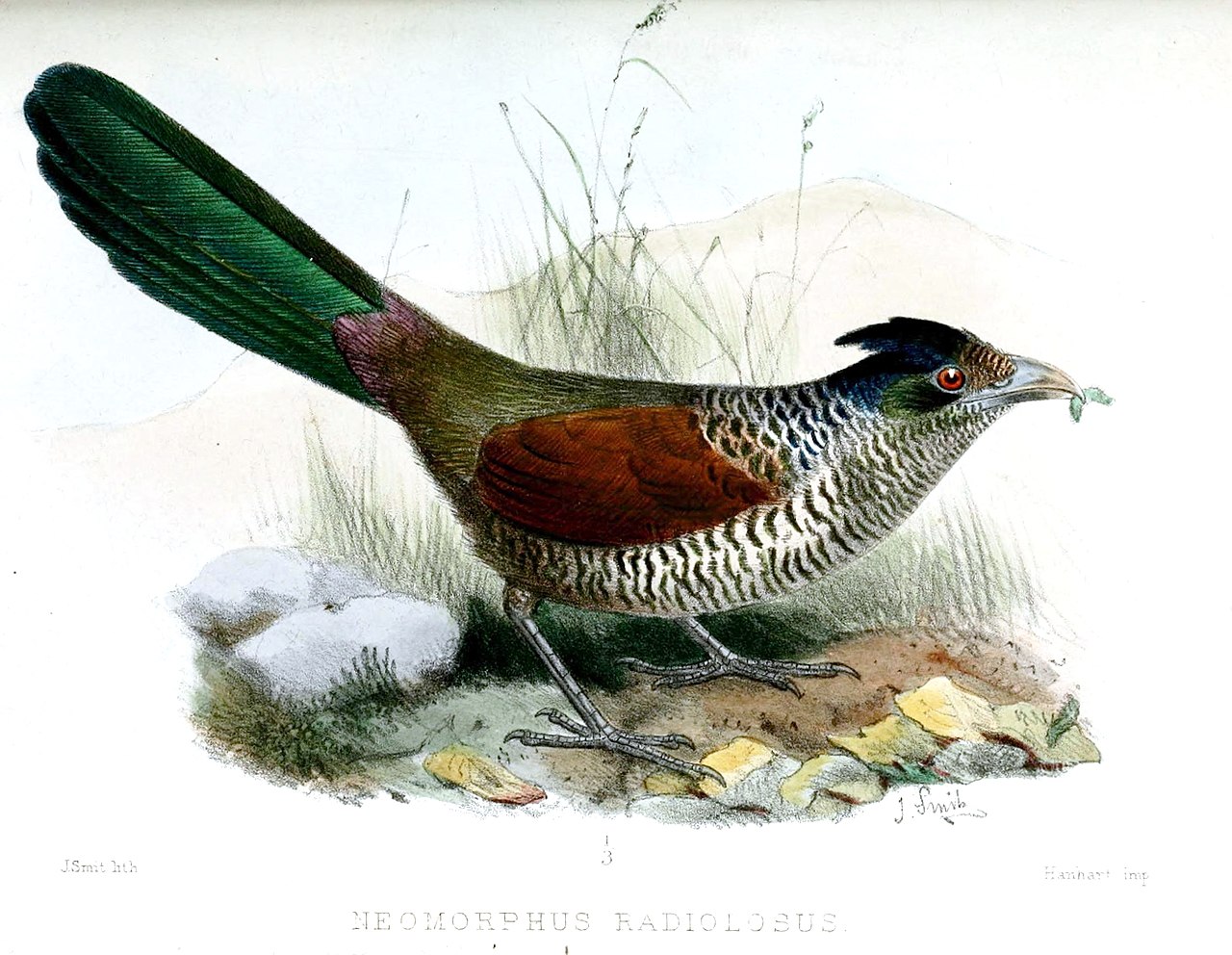
The banded bay cuckoo or bay-banded cuckoo is a species of small cuckoo found in the Indian subcontinent and Southeast Asia. Like others in the genus they have round nostrils. They are usually founded in well-wooded areas mainly in the lower hills. Males sing from exposed branches during the breeding season, which can vary with region. They are distinctive both in their calls as well as plumage with a white eyebrowed appearance and the rufous upperparts with regular dark bands and the whitish underside with fine striations.
Region
Indian Subcontinent and Southeast Asia
Typical Environment
Occurs from India and Sri Lanka through Nepal, Bangladesh, and Myanmar into Thailand, Laos, Cambodia, Vietnam, Peninsular Malaysia, Sumatra, Java, and Borneo. It frequents forest edges, secondary woodland, bamboo thickets, and well-wooded plantations, and also enters mature gardens near forests. Most often seen in lower hill zones and foothills, where it perches quietly within the mid-canopy. It tends to avoid open country, preferring broken woodland and scrub near water.
Altitude Range
0–1800 m
Climate Zone
Tropical
Ease of Keeping
Beginner friendly: 1/5
A brood parasite, the banded bay cuckoo lays its eggs in the nests of smaller passerines, leaving them to raise its young. Typical hosts include ioras, prinias, and other small warblers. It is often detected by its clear, whistled call delivered from exposed perches. The species favors well-wooded habitats and low hill country across South and Southeast Asia.


Head pattern
Temperament
secretive but vocal
Flight Pattern
short rapid wingbeats between perches
Social Behavior
Generally solitary or in pairs outside the breeding season. As an obligate brood parasite, it does not build a nest; females deposit eggs in the nests of suitable small passerines. Males sing persistently from exposed branches during the breeding period, which varies locally with rainfall and season.
Migratory Pattern
Partial migrant with local and elevational movements; largely resident across much of its range
Song Description
Gives a clear, whistled series of notes, often a repeated, slightly descending phrase. Calls carry well through woodland and are a primary means of detection. Alarm notes are softer and less musical.
Plumage
Rufous to chestnut upperparts with distinct dark barring; whitish underparts finely streaked and barred across the breast and flanks. A clean white supercilium contrasts with a darker eye-stripe. The tail is rufous with narrow dark bars and a paler tip.
Diet
Feeds mainly on insects, especially caterpillars including hairy species, as well as beetles, mantises, and other arthropods. It gleans prey from foliage and branches and occasionally sallies to catch flying insects. Small invertebrates are swallowed whole or beaten against a perch to subdue.
Preferred Environment
Forages in the mid to upper canopy of forest edges, clearings, and secondary growth. Also hunts along wooded streams and in tree-lined plantations where prey is abundant.