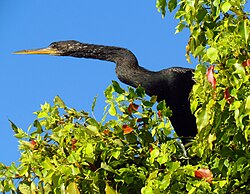
The anhinga, sometimes called snakebird, darter, American darter, or water turkey, is a water bird of the warmer parts of the Americas. The word anhinga comes from a'ñinga in the Brazilian Tupi language and means "devil bird" or "snake bird". The origin of the name is apparent when swimming: only the neck appears above water, so the bird looks like a snake ready to strike. They do not have external nares (nostrils) and breathe solely through their epiglottis.
Region
Tropical and subtropical Americas
Typical Environment
Found from the southeastern United States through Central America and much of South America, especially around slow-moving freshwater. Prefers swamps, marshes, oxbow lakes, mangroves, and calm rivers with abundant perches. Often seen drying its wings on snags or low branches over water. Rarely uses fast-flowing rivers or open marine waters except sheltered estuaries.
Altitude Range
Sea level to 1200 m
Climate Zone
Tropical
Ease of Keeping
Beginner friendly: 1/5
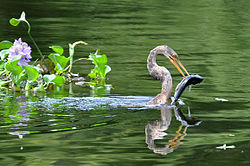
Also called snakebird, it swims with only its long neck above water, resembling a snake. Its feathers are less waterproof than those of cormorants, which helps it dive but requires frequent wing-drying in the sun. It spears fish with its sharp, dagger-like bill and flips them to swallow headfirst. Anhingas lack external nares (nostrils).


Skeleton, showing the hinge-like articulation between the eighth and ninth cervical vertebrae.






Temperament
wary and semi-colonial
Flight Pattern
soaring glider with intermittent flapping
Social Behavior
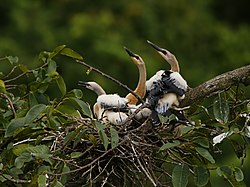
Often perches and roosts communally, especially near good fishing spots. Nests colonially in trees or shrubs over water, frequently alongside herons and cormorants. Pairs are typically seasonally monogamous; both sexes build the stick nest and share incubation and chick rearing.
Migratory Pattern
Partial migrant
Song Description
Generally quiet away from colonies, but at nesting sites gives dry clicks, croaks, and grating calls. Males produce sharp, clattering notes during displays; calls are more mechanical than musical.
Plumage
Glossy black to dark brown body with silvery streaks and chevrons on the upper wings; females have a buff to brown head and neck contrasting with a darker body.
Diet
Primarily eats small to medium fish, which it pursues underwater using powerful kicks. Also takes amphibians, aquatic invertebrates, and occasionally small reptiles. It spears prey with its bill and then tosses it to swallow headfirst, reducing the risk of spines catching.
Preferred Environment
Feeds in calm, shallow freshwater such as swamps, marsh edges, lagoons, and vegetated lake margins. Often hunts near submerged logs or emergent vegetation that provide cover and perches. Less commonly forages in brackish mangroves.