The Andean cock-of-the-rock, also known as tunki (Quechua), is a large passerine bird of the cotinga family native to Andean cloud forests in South America. It is the national bird of Peru. It has four subspecies and its closest relative is the Guianan cock-of-the-rock.
Region
Andes Mountains
Typical Environment
Occurs along the humid Andean slopes from western Venezuela through Colombia and Ecuador to Peru and Bolivia. It inhabits dense montane cloud forests, especially along ravines and near rocky outcrops and waterfalls. Birds favor areas with abundant fruiting trees and often use forest edges and natural clearings for display. Steep cliffs and boulders provide essential nesting substrates.
Altitude Range
500–2400 m
Climate Zone
Highland
Ease of Keeping
Beginner friendly: 1/5
Males gather at communal leks where they perform dramatic displays with bowing, wing-fluttering, and loud calls to attract females. Nests are mud-and-vegetation cups plastered to vertical rock faces near streams, giving the species its name. It is the national bird of Peru and a vital seed disperser for many Andean forest trees.


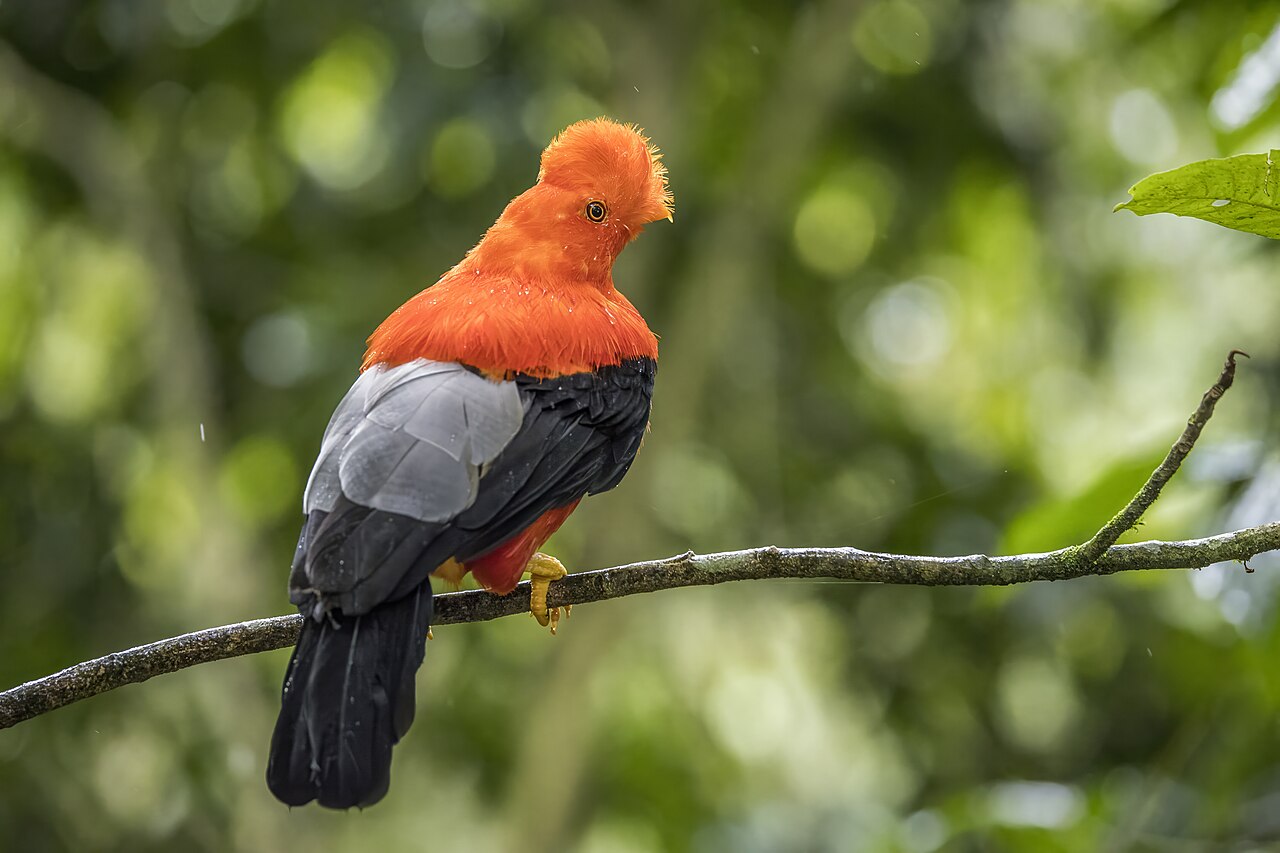
Male R. p. sanguinolentusshowing back feathers

Immature male at the Cincinnati Zoo, US
Temperament
secretive in dense forest but highly social at leks
Flight Pattern
short, direct flights with rapid wingbeats between perches
Social Behavior
Males form leks where dozens may display on traditional perches, competing visually and vocally. The species is strongly polygynous; females select mates and then nest and rear young alone. Nests are attached to rock faces, often near flowing water.
Migratory Pattern
Resident
Song Description
Calls at leks are loud, harsh croaks, grunts, and squeals, interspersed with snapping and wing-whirring sounds. Outside displays, vocalizations are softer and less frequent, often given from concealed perches.
Plumage
Males are brilliantly colored with a large, disk-like crest and contrasting dark wings and tail, often showing a pale grey shoulder panel. Females are darker, mostly brownish-olive with a smaller crest and more subdued patterning.
Diet
Primarily consumes a wide variety of fruits, swallowing them whole and later dispersing seeds across the forest. It supplements its diet with insects and other small invertebrates, especially during breeding. Foraging typically occurs from mid-story to canopy, moving between fruiting trees.
Preferred Environment
Feeds in humid cloud forest along ravines, forest edges, and clearings with fruiting trees. It often visits forest gaps and streamside vegetation where fruit is abundant.