

The American bushtit, or simply bushtit, is a social songbird belonging to the monotypic genus Psaltriparus. It is one of the smallest passerines in North America and it is the only species in the family Aegithalidae found in the Americas; the other eleven species occur in Eurasia.
Region
Western North America
Typical Environment
Occurs from southern British Columbia through the U.S. West Coast and interior West into northern and central Mexico. Prefers open woodlands, oak savanna, chaparral, pinyon-juniper, riparian corridors, and mixed conifer edges. Readily uses suburban parks, hedgerows, and landscaped neighborhoods where dense shrubs provide cover. Typically occupies areas with ample low to mid-level foliage for gleaning insects. In mountainous regions it follows suitable scrub and woodland along slopes and canyons.
Altitude Range
Sea level to 3000 m
Climate Zone
Temperate
Ease of Keeping
Beginner friendly: 1/5
The American bushtit is one of the smallest passerines in North America and the only Aegithalidae species in the Americas. Highly social, it forages in bustling flocks and often engages in cooperative breeding, with helpers assisting a nesting pair. It weaves a remarkable, pendulous, sock-like nest bound with spider silk and lined with plant down. Despite its tiny size, it thrives in a wide range of scrub and woodland habitats, including urban parks and gardens.


Male 'Pacific' bushtit in Chilliwack, British Columbia.

Male 'interior' bushtit in Utah.

Male 'black-eared' bushtit in Mexico City.
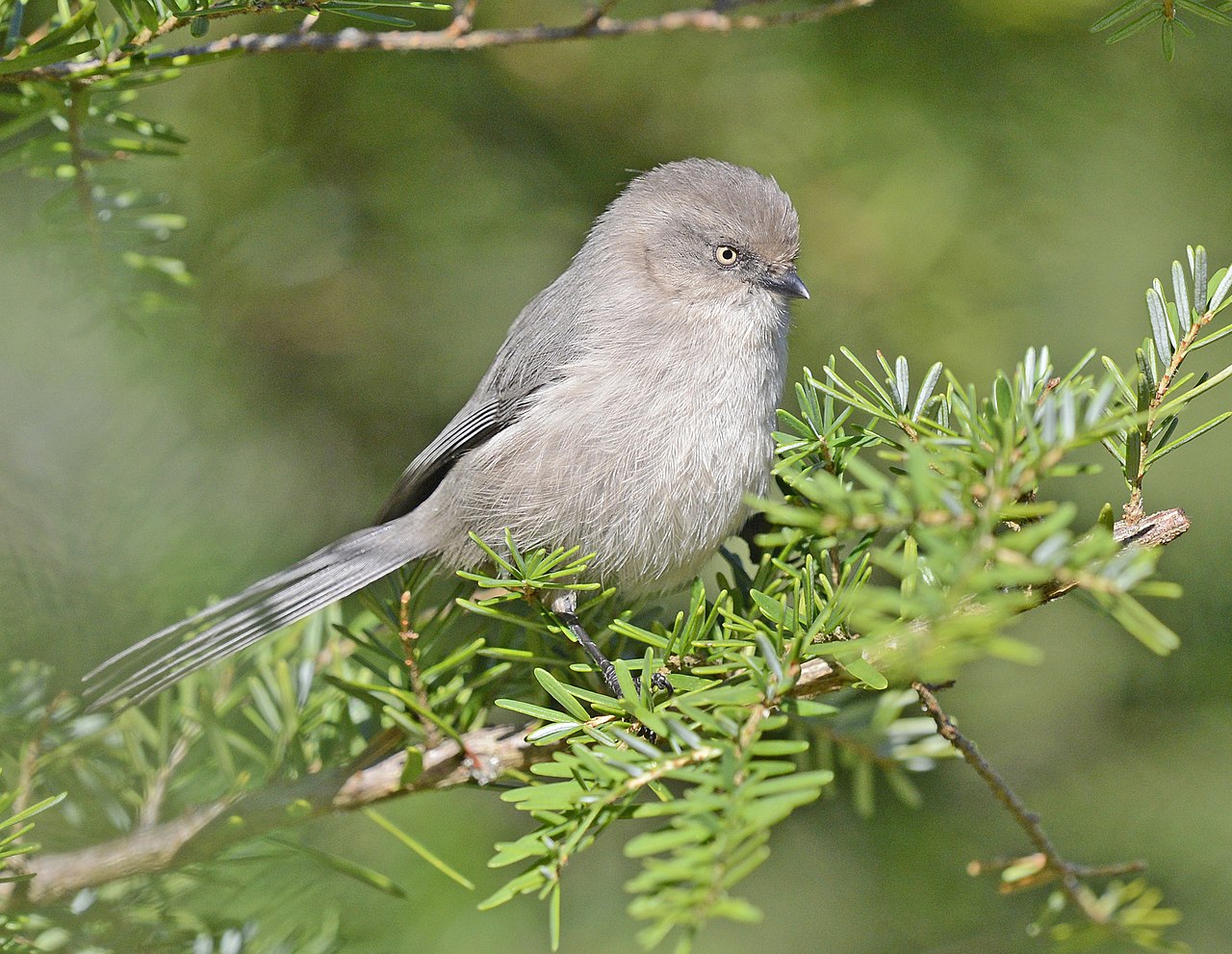
Female 'Pacific' bushtit in Western Washington state.

Female in southern Arizona, intermediate between interior and black-eared.

Congregating on feeder, Tumwater, Washington


Temperament
social and active
Flight Pattern
short rapid wingbeats with fluttery, weak flights between shrubs
Social Behavior
Usually travels in lively flocks of 10–40 birds outside the breeding season, keeping constant contact calls. Breeding pairs often receive help from additional flock members that assist with feeding and defense. Nests are intricate, pendulous pouches woven from spider silk, lichens, and plant fibers and are suspended in shrubs or trees.
Migratory Pattern
Resident
Song Description
A continuous series of high, thin, lisping notes and tinkling trills, often given by multiple flock members. Contact calls are very high-pitched tsit or tsee notes that create a constant soft chatter.
Plumage
Soft, plain gray to brownish-gray with slightly paler underparts; plumage appears fluffy with a long, narrow tail.
Diet
Feeds primarily on small arthropods such as aphids, leafhoppers, caterpillars, scale insects, and spiders. Gleans insects and eggs from leaves, twigs, and bark, often hanging upside down to probe dense foliage. In winter it occasionally takes tiny seeds or berries when insects are scarce.
Preferred Environment
Forages in dense shrubs, oaks, chaparral, riparian thickets, and the lower canopies of mixed woodlands. Common in residential areas with hedges, native plantings, and mature shade trees.


