

The American coot, also known as a mud hen or pouldeau, is a bird of the family Rallidae. Though commonly mistaken for ducks, American coots are only distantly related to ducks, belonging to a separate order. Unlike the webbed feet of ducks, coots have broad, lobed scales on their lower legs and toes that fold back with each step to facilitate walking on dry land. Coots live near water, typically inhabiting wetlands and open water bodies in North America. Groups of coots are called covers or rafts. The oldest known coot lived to be 22 years old.
Region
North America and Central America
Typical Environment
Found across Canada and the United States into Mexico, Central America, and the Caribbean, frequenting freshwater wetlands, marshes, ponds, lakes, and slow-moving rivers. They readily use artificial habitats such as reservoirs, urban park lakes, and irrigation canals. During winter they expand into coastal bays, estuaries, and flooded agricultural fields. Breeding typically occurs in marshes with dense emergent vegetation like cattails and bulrush. They are common migrants across interior flyways and winter in milder southern regions.
Altitude Range
0–3500 m
Climate Zone
Temperate
Ease of Keeping
Beginner friendly: 2/5
Often mistaken for ducks, American coots are rails with lobed toes that help them swim and walk over marsh vegetation. They build floating nests anchored to reeds and sometimes practice intraspecific brood parasitism. Coots form large rafts outside the breeding season and can run across the water to take flight. The oldest known individual lived 22 years.


Compared to a gadwall

American coot on take-off

Fighting
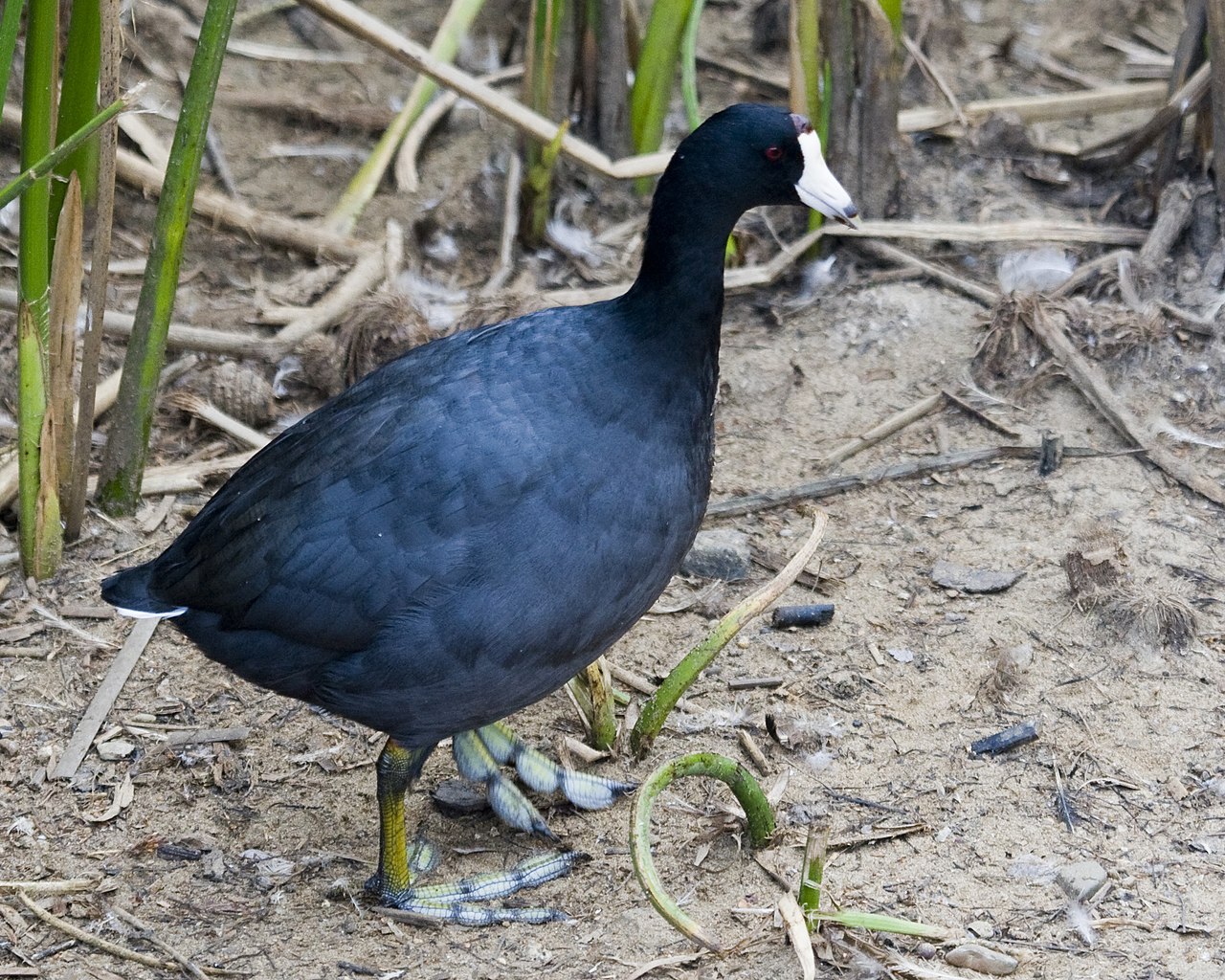
Note feet and red top of frontal shield

The American coot is regularly found in sizable flocks.

"Caribbean coot" type with fully white frontal shield


Mating

Coot standing over its nest. Note red eyes

Nesting American coot

American coot skeleton (Museum of Osteology)


A bald eagle pursuing an American coot

1835 illustration by J. J. Audubon
Temperament
social and active
Flight Pattern
short rapid wingbeats with labored takeoff after running across the water
Social Behavior
Outside the breeding season, coots gather in large rafts and feed cooperatively, though squabbles are common. During breeding they defend territories and build floating nests in dense emergent vegetation. Pairs are generally monogamous for a season, and intraspecific brood parasitism occurs.
Migratory Pattern
Partial migrant
Song Description
Vocalizations are a series of grating clucks, croaks, and honks rather than melodious songs. Calls carry well over water and are used for contact, aggression, and alarm.
Plumage
Uniform slate-gray to blackish body with a paler belly and white undertail flashes; feathers appear smooth and matte.
Diet
They consume aquatic plants, algae, and seeds, supplemented with insects, snails, crustaceans, and occasional small fish or eggs. They dabble, dive briefly, and graze along shorelines or lawns. Coots also pick food from the water surface and may kleptoparasitize other waterbirds.
Preferred Environment
Shallow marshes and lake margins with emergent vegetation are preferred for foraging. They also feed in open water, urban ponds, and flooded fields, often near cover.


