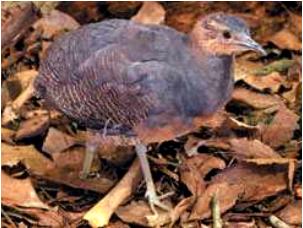
The yellow-legged pigeon is a bird species in the family Columbidae. It is found in the Bismarck and Solomon archipelagos. Its natural habitats are subtropical or tropical moist lowland forests and subtropical or tropical moist montane forests. It is threatened by habitat loss. It was formerly classified as Endangered by the IUCN. But new research has shown it to be not as rare as it was believed; consequently, it was downlisted to Vulnerable in 2008.
Region
Bismarck and Solomon Archipelagos
Typical Environment
Found on large, forested islands including New Britain, New Ireland, Bougainville, and parts of the central Solomon Islands. It inhabits primary and mature secondary lowland rainforest as well as lower montane forest. The species favors tall, fruiting trees and is most often detected by flight calls as it moves between feeding sites. It persists in some selectively logged areas but declines where forest cover is heavily fragmented.
Altitude Range
0–1500 m
Climate Zone
Tropical
Ease of Keeping
Beginner friendly: 1/5
This elusive forest pigeon is native to the Bismarck and Solomon archipelagos and spends much of its time high in the canopy. It was once listed as Endangered, but improved survey data led to a downlisting to Vulnerable in 2008; habitat loss and hunting remain key threats. Its name reflects its pale head and its distinctive bright yellow legs, which help separate it from other dark Pacific pigeons.
Temperament
solitary and shy
Flight Pattern
strong flier
Social Behavior
Usually seen singly or in pairs, occasionally in small loose groups at fruiting trees. Nests are presumed to be simple twig platforms placed high in trees, like many Columba pigeons. Breeding behavior is poorly documented, but pairs likely defend small territories around nest sites.
Migratory Pattern
Resident
Song Description
Vocalizations are low, booming coos delivered from within the canopy, often carrying over distance. Calls are infrequent and easily overlooked amid forest sounds.
Plumage
Mostly dark slaty-gray body with a noticeably paler gray to whitish head and nape; overall smooth, uniform plumage with minimal patterning.
Diet
Primarily consumes fruits, especially figs and other native drupes and berries. Will also take cultivated fruits near forest edges when available. Seeds may be ingested incidentally while feeding on fleshy fruits.
Preferred Environment
Feeds high in the forest canopy at fruiting trees, moving along ridgelines and valleys to locate crops. Occasionally visits secondary growth or edges where fruiting trees are abundant.