
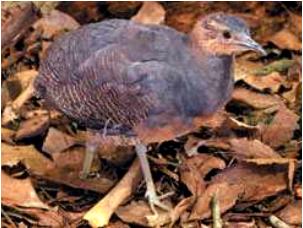
The yellow-legged tinamou is a species of tinamou found in wooded and shrubby habitats in tropical and subtropical eastern Brazil. This superficially quail-like bird has a grey-brown plumage and two easily separated subspecies. It has declined due to human activities, and is therefore listed as Near Threatened by the IUCN.
Region
Eastern Brazil
Typical Environment
Occurs in lowland and foothill Atlantic Forest, semi-deciduous woodlands, and dense secondary growth. It also uses forest edges, thickets, and scrubby habitats, sometimes entering shaded plantations and overgrown clearings where cover is ample. Prefers areas with a closed understory and leaf-littered ground for foraging and concealment. Avoids very open habitats but can persist in fragmented forest mosaics if hunting pressure is low.
Altitude Range
Sea level to 1200 m
Climate Zone
Tropical
Ease of Keeping
Beginner friendly: 2/5
The yellow-legged tinamou is a shy, ground-dwelling bird of Brazil’s Atlantic Forest and adjacent scrub, where it slips through dense understory and is more often heard than seen. Males incubate and raise mixed clutches from multiple females, a hallmark of tinamou breeding. Habitat loss and hunting have driven declines, and the species is assessed as Near Threatened by global authorities.


Crypturellus n. zabele
Temperament
shy and secretive
Flight Pattern
short rapid wingbeats with explosive flush, followed by a brief glide
Social Behavior
Usually solitary or in pairs, remaining close to dense cover. Nests are simple ground scrapes concealed in vegetation. Males incubate and tend chicks, often from eggs laid by multiple females. Territorial calling is common at dawn and dusk.
Migratory Pattern
Resident
Song Description
Gives low, mournful whistles that carry far through forest, often in a slow, repetitive series. Vocalizations are most frequent at dawn and dusk and can sound ventriloquial from within dense cover.
Plumage
Overall grey-brown to olive-brown with fine mottling and faint barring on the mantle and flanks; underparts paler buff-grey with subtle vermiculation.
Diet
Forages mainly on fallen fruits and seeds, supplemented with insects, small arthropods, and occasionally tender plant matter. Picks food from the leaf litter and low vegetation, swallowing small items whole. May follow fruiting trees to capitalize on seasonal abundance and ingests small grit to aid digestion.
Preferred Environment
Feeds on the forest floor in shaded understory, along edges, and in tangles of secondary growth. Often uses paths and natural openings to move quietly between foraging patches while remaining close to cover.


