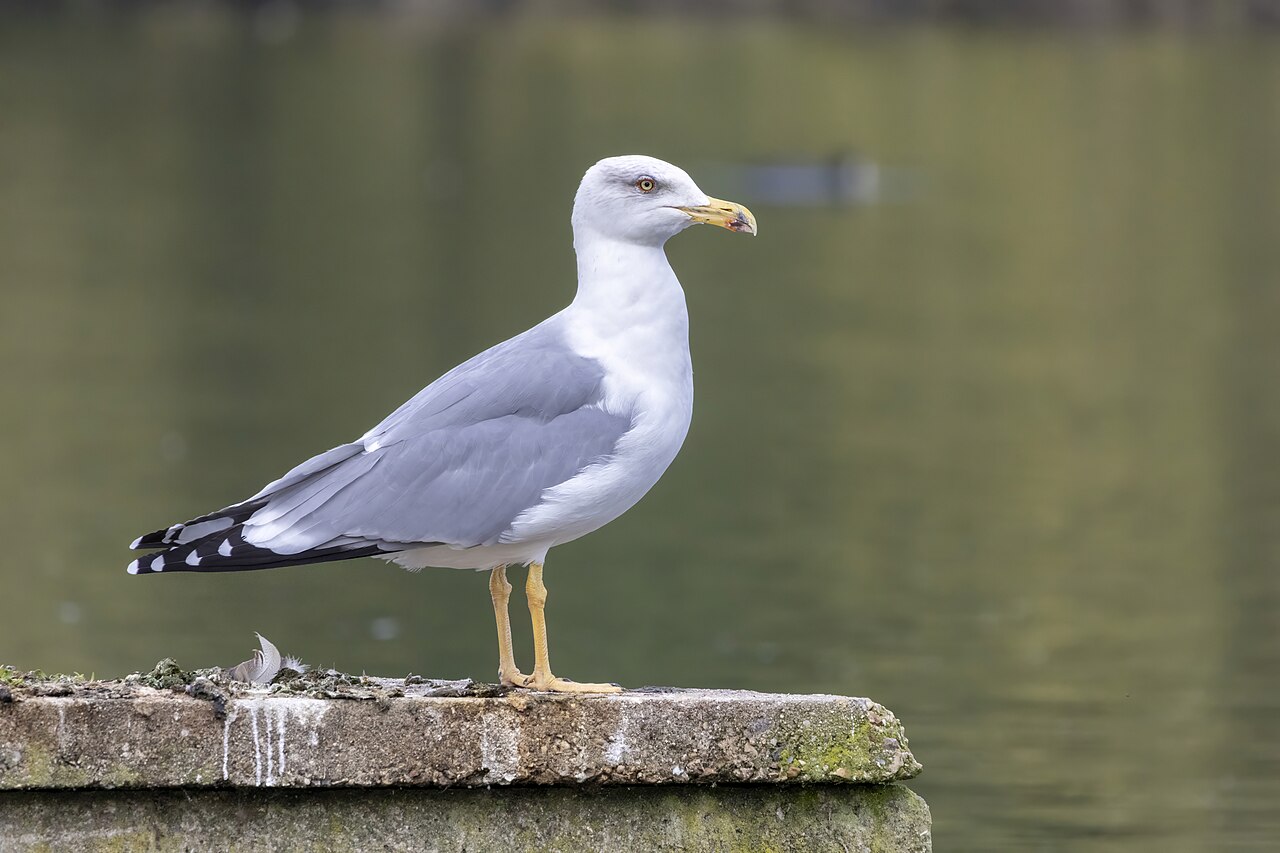
The yellow-legged gull or western yellow-legged gull is a large gull found in Europe, the Middle East and North Africa, which has only recently achieved wide recognition as a distinct species. It was formerly treated as a subspecies of either the Caspian gull L. cachinnans, or more broadly as a subspecies of the herring gull L. argentatus. The genus name is from Latin Larus which appears to have referred to a gull or other large seabird, and the species name honours the German zoologist Karl Michahelles.
Region
Mediterranean Basin and Western Palearctic coasts
Typical Environment
Breeds widely around the Mediterranean and Black Seas, on coastal cliffs, islands, harbors, and increasingly on urban structures. It also occurs along Atlantic coasts from the Iberian Peninsula north to western France and disperses to the British Isles and inland reservoirs. Non-breeding birds range broadly along European and North African coasts and move through large river systems. The species readily exploits human-altered habitats including ports, fisheries, agricultural fields, and landfills.
Altitude Range
Sea level to 1500 m
Climate Zone
Temperate
Ease of Keeping
Beginner friendly: 1/5
Recently split from the herring gull complex, the yellow-legged gull is now widely recognized as a distinct species centered around the Mediterranean. Adults have noticeably yellow legs, a deeper yellow bill with a prominent red gonys spot, and less head streaking in winter than herring gulls. It adapts readily to human environments, nesting on rooftops and foraging at fishing ports and landfills. Hybridization with closely related gulls can occur in contact zones, complicating identification.


Yellow-legged gull in Porto, Portugal

Mating on roof-top, Constanta, Romania

Nominate L. m. michahellis, Elba

Head of a two-year old yellow-legged gull taken at the Breton coast

Juvenile with open beak

Yellow-legged gull eating a Eurasian collared dove in Barcelona

Larus michahellis atlantis - MHNT.

Three yellow-legged gull eggs in a ground nest in the Azores.

A yellow-legged gull egg in a ground nest with a 2-euro coin for scale.
Temperament
bold and opportunistic
Flight Pattern
strong flier with steady wingbeats and frequent soaring glides
Social Behavior
Typically nests colonially on coastal cliffs, islands, and rooftops, often in dense mixed-age groups. Pairs are monogamous within a season and both sexes participate in incubation and chick-rearing. Outside the breeding season, forms loose to large flocks at feeding sites and roosts.
Migratory Pattern
Partial migrant
Song Description
Vocalizations include loud, ringing yelps and cackles reminiscent of herring gull but slightly deeper and harsher. Also gives rapid alarm series and nasal calls during territorial disputes and at colonies.
Plumage
Adult with pale grey mantle, white head and underparts, and black wingtips with white mirrors; minimal winter head streaking. Juveniles and immatures are mottled brown with contrasting pale inner primaries and gradually acquire adult plumage over several years.
Diet
An opportunistic omnivore taking fish, marine invertebrates, insects, small vertebrates, carrion, and eggs or chicks of other birds. Frequently scavenges at fishing ports and trawler discards, and readily consumes refuse at landfills. Will kleptoparasitize other birds and forage in agricultural fields for invertebrates.
Preferred Environment
Forages along shorelines, estuaries, and harbors, as well as inland lakes, reservoirs, and rivers. Regularly uses urban areas and dumps, exploiting human food sources and fishing activity.